
 close
close


 LOGIN
LOGINYou are viewing 1 of 1 free articles
1v1 Wednesdays: a well-rounded test for your players
Forest Green Rovers’ head of coaching Michael Wright explains the ’winner v winner, loser v loser’ contests he uses to test players’ energy and resilience.



I do something with my groups called 1v1 Wednesdays.
It is 20 minutes to half an hour and is pretty brutal, if I’m being completely honest. It’s really good for their tactical understanding and they’ll work on a bit of technique - but psychologically is probably the bit, for me, that really stands out.
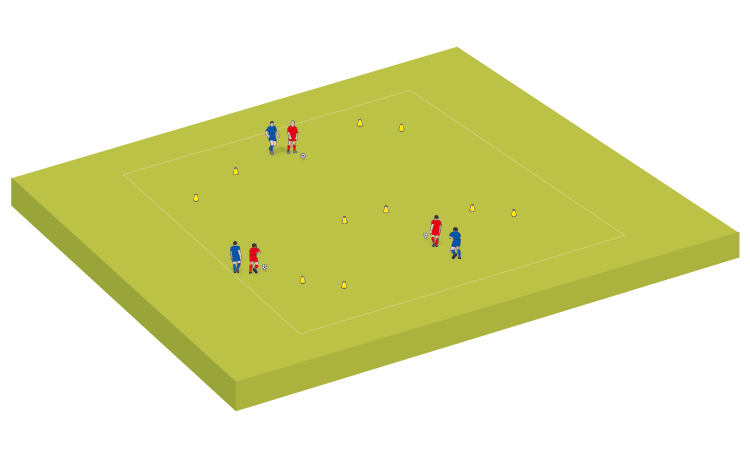
On the next page is an example - a 20x20 grid with five gates inside it. For the gates, you would have two cones that are maybe two yards apart.
You might have three or four pairs within that session – essentially, the idea is that every gate you go through, you get a point. Obviously, if the other person wins it, they then try and get through the gates. If you dribble out of the grid, it’s the other person’s ball.
A little added stipulation is if you can do a hook turn back through the gate, that gets you two goals – and you can’t go through the same gate twice.
What you might say as a player is, ’I’m going to go round this gate, do my hook turn back through, because I’ve sold them on where I’m going to go, and that’s going to get me two goals’.
That might last for 45 seconds or [up to] two minutes. It is really hard work – it sounds quite easy, but actually to play for that period of time in a 1v1 is really hard work.
You then say stop, on the whistle. My next job is to say ‘winners find another winner, losers find another loser, go again’. That’s essentially what that practice looks like, for 20 minutes. Maybe start off with it being 10 minutes, and work it up as their fitness gets better.
What you are essentially asking the players to do is understand the tactical elements of the game – how are they going to get through all these gates as quickly as they possibly can?
When are they going to use their hook turn? When is the right time? Because if they just turn into someone without looking, they’re going to lose it.
And when you do ‘winners find another winner, losers find another loser’, you end up with two individuals that haven’t lost yet. They eventually keep finding one another.
Psychologically, [it’s about] ’when I lose, what’s my next action?’. Are they going to get really upset by the fact they’ve lost this game? Or are they going to go, ’You know what, I’ve got another game in 20 seconds. I need to go and find another partner, reset, figure out what their strengths are and we need to play again’.
That for me is a really nice way of them quickly understanding the game, identifying strengths, psychologically testing them and physically testing them.
My job within that as a coach is obviously to manage the fouls so it doesn’t get out of hand.

Related Files

Michael Wright
Latest Issue
Subscribe Today
Subscriber Testimonials

Gerald Kearney, Downtown Las Vegas Soccer Club

Paul Butler, Florida, USA

Rick Shields, Springboro, USA

Tony Green, Pierrefonds Titans, Quebec, Canada
Subscribe Today
Newsletter Sign Up
Coaches Testimonials
Gerald Kearney, Downtown Las Vegas Soccer Club
Paul Butler, Florida, USA
Rick Shields, Springboro, USA
Tony Green, Pierrefonds Titans, Quebec, Canada
Subscribe Today
Latest Issue

Discover the simple way to become a more effective, more successful soccer coach
In a recent survey 89% of subscribers said Soccer Coach Weekly makes them more confident, 91% said Soccer Coach Weekly makes them a more effective coach and 93% said Soccer Coach Weekly makes them more inspired.
*includes 3 coaching manuals
Get Weekly Inspiration
All the latest techniques and approaches


Soccer Coach Weekly offers proven and easy to use soccer drills, coaching sessions, practice plans, small-sided games, warm-ups, training tips and advice.
We've been at the cutting edge of soccer coaching since we launched in 2007, creating resources for the grassroots youth coach, following best practice from around the world and insights from the professional game.
