
 close
close


 LOGIN
LOGINWhat is moving with the ball?
Carl Wild gives first-timers a guide on dribbling and running with the ball – and they are not the same thing.
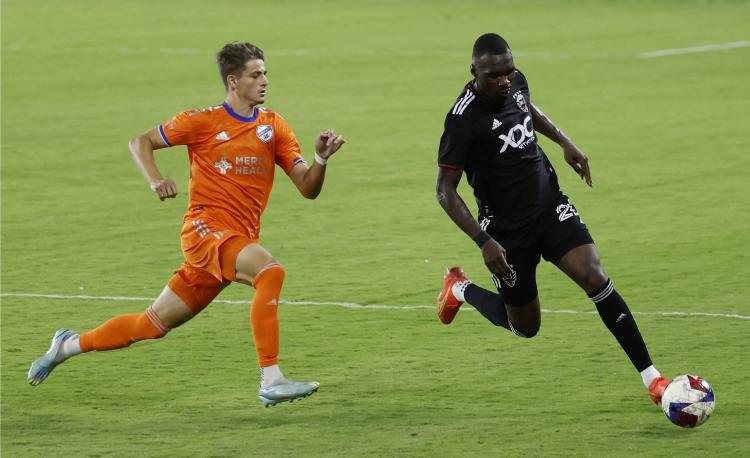
Moving with the ball involves a player travelling from one area of the field to another while keeping possession.
This could be over a small distance or a much greater one. It could entail having to get past an opponent or multiple opponents, or it could be completely unopposed.
Rarely, though, does it involve players travelling in a straight line. Even when they are unopposed, it is likely they will need to alter the pathway they are on.
Finally, for it to be fully successful, the player will need to complete an additional action at the end, such as a shot on goal, a pass to a team-mate, or a cross.
Why do we move with the ball?
Players will choose or be forced to travel with the ball for a number of reasons, such as to move away from danger or get closer to the opposition’s goal.
Whatever the reason, a player moving with the ball as an individual can have a significant influence on the game, as it will often impact their opponents’ defensive organisation.
Let’s look closer at the reasons for moving with the ball.
"Moving with the ball gives players a chance to get it away from danger..."
To secure possession: When initially gaining possession of the ball, players will sometimes find themselves under pressure from one or more defenders, as the area in which they received the pass has a limited amount of space.
To get the ball away from this danger, players can either look to pass it on to a team-mate or they may decide to travel with it themselves.
Moving with the ball in these situations gives players a chance to get it away from danger and secure possession.
Once they have done so, it also provides the player with more time and space to execute their next action, which makes it easier than if they were under pressure in a congested area of the field.
To beat an opponent: Going past an opponent, particularly if you are travelling towards the opposition’s goal or are already close to it, can be very beneficial.
It forces another opposition player to engage the ball, moving them away from their previous position, meaning their team will not be as organised or as compact as they would like to be.
Forcing another opponent to engage the player with the ball will open up space on the pitch for them or a team-mate.
Be a more effective, more successful youth soccer coach
- Win more games, without sacrificing the crucial element of fun
- Develop every player, regardless of vast differences in ability
- Run a respected, professional programme - even with a full-time job and limited time
Subscribe for full access
Or register and unlock 2 free articles,
receive our weekly newsletter, and
get a FREE coaching e-book.
Or if you are already a subscriber login for full access.

Carl Wild
Latest Issue
Subscribe Today
Subscriber Testimonials

Gerald Kearney, Downtown Las Vegas Soccer Club

Paul Butler, Florida, USA

Rick Shields, Springboro, USA

Tony Green, Pierrefonds Titans, Quebec, Canada
Subscribe Today
Newsletter Sign Up
Coaches Testimonials
Gerald Kearney, Downtown Las Vegas Soccer Club
Paul Butler, Florida, USA
Rick Shields, Springboro, USA
Tony Green, Pierrefonds Titans, Quebec, Canada
Subscribe Today
Latest Issue

Discover the simple way to become a more effective, more successful soccer coach
In a recent survey 89% of subscribers said Soccer Coach Weekly makes them more confident, 91% said Soccer Coach Weekly makes them a more effective coach and 93% said Soccer Coach Weekly makes them more inspired.
*includes 3 coaching manuals
Get Weekly Inspiration
All the latest techniques and approaches


Soccer Coach Weekly offers proven and easy to use soccer drills, coaching sessions, practice plans, small-sided games, warm-ups, training tips and advice.
We've been at the cutting edge of soccer coaching since we launched in 2007, creating resources for the grassroots youth coach, following best practice from around the world and insights from the professional game.
