
 close
close


 LOGIN
LOGINDeveloping soccer skills: passing
Moritz Kossmann discusses the secret language of transferring the ball with Steph Fairbairn.
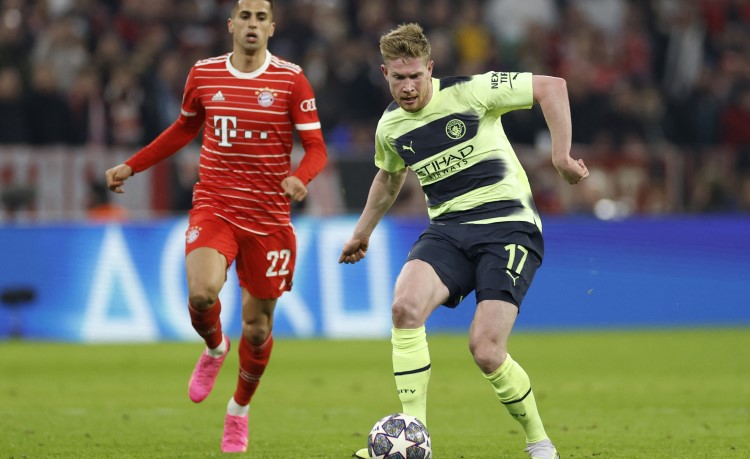
Passing is more than just transferring the ball from one player to the other. At the elite levels, in particular, it is like a secret language, full of non-verbal signals and triggers, underpinned by players’ ability to see the bigger picture in their heads.
Moritz Kossmann - who has now moved on from his role at Ubuntu Football Academy to become DStv Diski Challenge coach and head of youth at Cape Town City - sat down with Steph Fairbairn to discuss how passing can be used as a form of communication, the decision-making that goes into it and why the actions after a pass are so crucial...
SCW: How important is communication between team-mates when it comes to passing?
MK: We can look at our team-mates and communicate with them verbally. We can also communicate with body language.
When we have played together with a team-mate for several years, it becomes much easier to read one another.
Let’s go to the highest level of the game and take, for example, the partnership between [Manchester City’s] Kevin De Bruyne and Erling Haaland.
When they play in a stadium of 60,000 people who are all roaring and screaming, I don’t think there’s massive amounts of verbal communication going on, compared to the amount of non-verbal communication.
I think that is where, at a high level, it becomes key for your strongest XI to play together as much as possible, because you learn to communicate in ever more subtle ways. And the more subtle this communication becomes, the more likely it is to create small space and time advantages over our opponents.
Perhaps what some would call intuitive understanding is really non-verbal communication. When De Bruyne does certain things, Haaland might understand that the ball is going to come here or go there and that gives him the chance to start his run slightly earlier than the opponent [is able to] and gives him enough space to finish the chance.
"What some would call intuitive understanding is really non-verbal communication..."
How we pass is also communication. If I pass to your furthest foot, and I’m a skilled player who is able to pass the ball accurately, then I might be communicating to you to make a forward action. I’ve passed to your furthest foot because I am trying to tell you to attack with your first touch.
But if I’m passing it to your nearest foot - the one closest to me in relation to the opponent’s goal and where you are on the field - then I might be communicating to you that there’s quite a large amount of opposition pressure behind you and you might be better served just controlling the ball and passing it backwards again.
That is a very simple way of using passing for communication.
A more prominent example is to pass the ball into space. Then, I’m communicating to you to go forward. [But by] passing into feet, I might be communicating to you to pass to a team-mate again.
It could also be the spin I’m putting on the ball or the power on the pass. For example, if I’m passing it quite hard to you, then I might be suggesting you use one touch only. If I’m passing softer, I might be trying to draw out opposition pressure. If I’m passing it medium-hard, I might be suggesting not to use one touch.
It’s crucial to interact efficiently on the football field and that is where football actions start, really.
Be a more effective, more successful youth soccer coach
- Win more games, without sacrificing the crucial element of fun
- Develop every player, regardless of vast differences in ability
- Run a respected, professional programme - even with a full-time job and limited time
Subscribe for full access
Or register and unlock 2 free articles,
receive our weekly newsletter, and
get a FREE coaching e-book.
Or if you are already a subscriber login for full access.
Latest Issue
Subscribe Today
Subscriber Testimonials
Gerald Kearney, Downtown Las Vegas Soccer Club

Paul Butler, Florida, USA

Rick Shields, Springboro, USA

Tony Green, Pierrefonds Titans, Quebec, Canada
Subscribe Today
Newsletter Sign Up
Coaches Testimonials
Gerald Kearney, Downtown Las Vegas Soccer Club
Paul Butler, Florida, USA
Rick Shields, Springboro, USA
Tony Green, Pierrefonds Titans, Quebec, Canada
Subscribe Today
Latest Issue

Discover the simple way to become a more effective, more successful soccer coach
In a recent survey 89% of subscribers said Soccer Coach Weekly makes them more confident, 91% said Soccer Coach Weekly makes them a more effective coach and 93% said Soccer Coach Weekly makes them more inspired.
*includes 3 coaching manuals
Get Weekly Inspiration
All the latest techniques and approaches


Soccer Coach Weekly offers proven and easy to use soccer drills, coaching sessions, practice plans, small-sided games, warm-ups, training tips and advice.
We've been at the cutting edge of soccer coaching since we launched in 2007, creating resources for the grassroots youth coach, following best practice from around the world and insights from the professional game.
