
 close
close


 LOGIN
LOGINFaith Jasper: Explaining your coaching methods
Since her teens, Faith Jasper has been shaping her coaching philosophy. In part one of a two-part chat with Scott Mowberry, she explains her methods


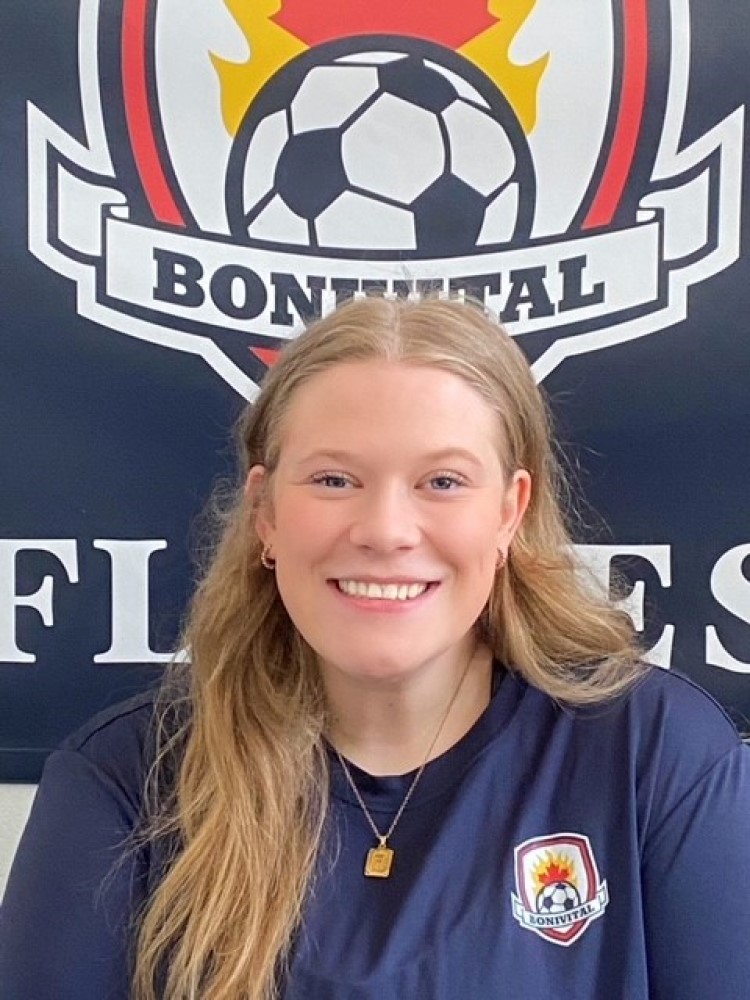
Faith Jasper took up coaching aged 14, when an opportunity arose to take some sessions in between her goalkeeper training.
She undertook her Canada Soccer National C license at the age of 18, the youngest in the group, and one of the only females.
Numerous coaching roles followed in her hometown of Regina in Saskatchewan, before she moved to Winnipeg to make use of her degree in sport and recreation studies as a recreation therapist.
Faith is head coach of Bonivital SC’s U14s girls premier team and assistant coach of the club’s U15s girls premier team.
She caught up with Scott Mowberry, from our friends at the Soccer Coaching Podcast, to talk about her coaching philosophy, how she defines the moments of the game, and why language is so important…
SM: How would you describe your coaching philosophy?
FJ: "I break it down as my ’personal’ - what I’m looking to get out of it - and then the technical and tactical moments of the game.
“If we’re going into my philosophical approach, I look a lot more at making meaningful relationships on and off the field and focusing on the athletes as humans, rather than robots. They are not there just to play soccer, they are there to have fun.
"I’m looking for players to become confident on the ball. We want to create ’ball hogs’ - we don’t want to encourage them to pass as soon as they get the ball.
"So [it’s about] making a fun-focused session, having players engaged as much as they can be, and creating that everlasting love for the game I was lucky enough to get and have been able to bring to my coaching.
"’Making good players, but better humans’ is what I always say.
“For my technical-tactical side, I am a big fan of breaking down the game for the players to build it back up. So I go by the four moments: AT, DT, AO and DO.
"AT is attacking transition - you win the ball and immediately you look to go forward. If you have space, you’re looking to dribble.
“AO, or attacking organization, would be [where] you win the ball and can’t go forward. You look to secure two passes and then move forward - it’s keeping possession rather than immediately looking to go.
“DT is defensive transition. That would be [where] you have just lost the ball. That’s what I call ’the hunt’ - you’re looking to win it back in 10 seconds.
"I’m looking for players to become confident on the ball - we want to create ’ball hogs’..."
“Then DO is defensive organization, which would be [where] you have just lost the ball and couldn’t win it back in 10 seconds. Now what? You look to get your line of attack set, organize your defensive players, that kind of thing.”
SM: What does a Faith Jasper coaching session look like?
FJ: "I always start with the Fifa 11+ warm-up. I grew up using that - it’s scientifically based and researched, and I believe it works.
"Then I move into a fun warm-up game, looking at getting more movement than skill on the ball. It doesn’t necessarily have to involve a ball at their feet, more of a movement and awareness piece than anything.
"It could be a game not even related to soccer, where it’s more movement-based and relationship-based.
“Following that, I do our first game, which is related to whatever theme is at hand. We pick one of the four moments and focus on that as the theme.
"That is our small-sided game, but there’s conditions that emphasize the theme we’re working towards.
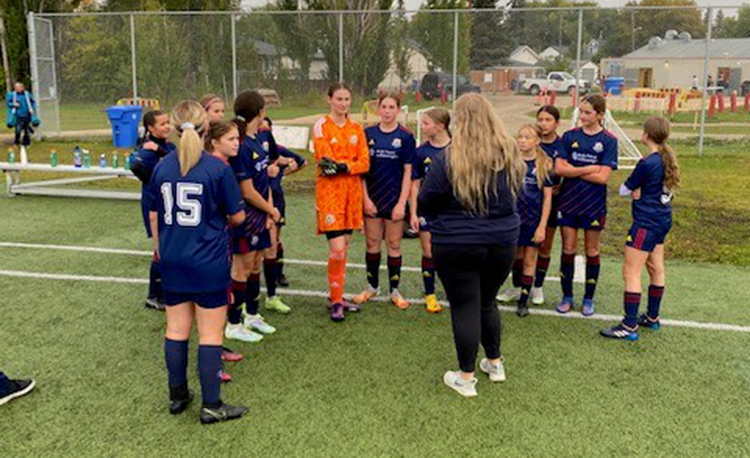
"If it is attacking transition, it’s looking at forcing those moments of transition to happen - so as soon as you win possession, you need to go forward.
"Your activity is related to the theme, but it’s not a small-sided game - it’s more of a controlled environment, [where] you’re working on what parts of that theme are.
“It’s breaking down the moment for them. So if we’re working on our dribbling, or 1v1 attacking, we’re breaking it down and explaining that to them.
“Then the last part is your second game, which is just a small-sided game with no restrictions. That should look like a proper soccer game.
"I sometimes put in a small restriction, but if not, then it’s just a regular game of soccer.
"That’s what my older age groups look like - the younger age groups are based along the same thing.
"With them, it’s a more introducing the basic fundamentals rather than focusing on narrowing down on the four moments.
“For a coaching lens, I still use the four moments, but I don’t break it down nearly as much as I do with the older girls."
SM: Detail seems very important to you. How do you go about getting that detail into the players that works in an effective and engaging way?
FJ: "With my older age groups, we do classroom sessions as well.
"[But] I like to make sure athletes don’t feel like they are in school. They go to school every day - soccer’s supposed to be that space to be creative, I don’t want it to ever feel like they’re in a lecture or being told what to do, because I am a big fan of creativity on the field.
“That being said, I think I have the tendency to coach a lot overhead. I coach as they’re playing, rather than stopping the game completely and bringing it in. That’s how I got taught to coach.
“I start all my sessions introducing what we are doing that day, so ensuring that all of us are on the same page.
"We use their terminology rather than using mine. We can use the four moments of the game as much as we want, but I’m not the one playing the game any more. They need to know what they are doing, not me. My time has passed.
“I really enjoy classroom sessions. We might break down a game we had that weekend and talk about what we looked like in it and what we found was beneficial - two things we did right, two things we could work on.
“In those sessions, I find the girls using the four moment terminology more than I did. I’m proud because I’m sitting here listening to them have these intellectual conversations and I am not contributing at all.
"We use their terms rather than mine. I’m not the one playing the game any more..."
“They’re having these conversations without me on the pitch. It’s so fun to watch the growth from when I first got them, having to introduce the four moments and break down the game.
"I had to explain to parents, ‘Hey, this might look like chaos right now because we’re breaking down the game, down to the foundation of it. In order to have a sturdy build up, you need a sturdy foundation’.
“You’re going to look like you have no idea what you are doing. That is normal. Create some sort of peace in the chaos. Use it to your advantage."
SM: How important is having the same vocabulary with your assistant coaches as well?
FJ: "When I first moved to Manitoba from Saskatchewan, I was coaching and using words and I could tell that no-one knew what I was saying and what I was asking.
"I would yell ‘Step!’ or ‘Push!’, and they had no idea what I was saying. They would just look at me. I looked at my assistant coaches and said, ‘What am I saying wrong?’.
“So [it’s] making sure we’re all on the same track and they know what I’m saying is so important.
"I’m trying to communicate with athletes and if they don’t know what I’m saying, that communication is absolutely pointless and it’s just going to confuse them more."
Related Files

Latest Issue
Subscribe Today
Subscriber Testimonials
Gerald Kearney, Downtown Las Vegas Soccer Club

Paul Butler, Florida, USA

Rick Shields, Springboro, USA

Tony Green, Pierrefonds Titans, Quebec, Canada
Subscribe Today
Newsletter Sign Up
Subscribe Today
Latest Issue
Discover the simple way to become a more effective, more successful soccer coach
In a recent survey 89% of subscribers said Soccer Coach Weekly makes them more confident, 91% said Soccer Coach Weekly makes them a more effective coach and 93% said Soccer Coach Weekly makes them more inspired.
*includes 3 coaching manuals
Get Weekly Inspiration
All the latest techniques and approaches


Soccer Coach Weekly offers proven and easy to use soccer drills, coaching sessions, practice plans, small-sided games, warm-ups, training tips and advice.
We've been at the cutting edge of soccer coaching since we launched in 2007, creating resources for the grassroots youth coach, following best practice from around the world and insights from the professional game.
