
 close
close


 LOGIN
LOGINYou are viewing 1 of 1 free articles
How to take a throw-in
It may seem simple to most, but can be a rather difficult technique for young or inexperienced players to get to grips with. Here’s a guide to coaching the throw.


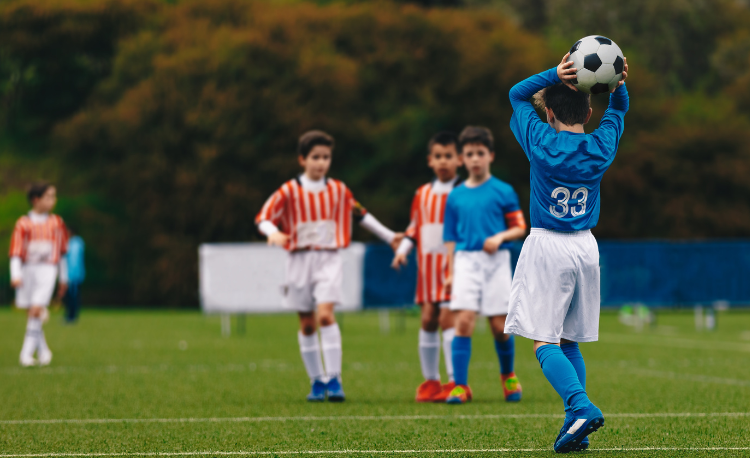
Put simply, a throw-in is a restart of play, in which a player throws the ball onto the pitch from the sideline.
If executed well, throw-ins can help a team keep possession and gain territory.
But what do you need to tell youngsters and novice players about technique, and how can you develop it from the basics?
What do the laws say?
For regulations on the throw-in, you must look at Law 15 of the International Football Association Board’s Laws of the Game.
The Law states: "A throw-in is awarded to the opponents of the player who last touched the ball, when the whole of the ball passes over the touchline, on the ground or in the air."
The player taking the throw-in – or ’the thrower’ – must:
- Stand facing the field of play
- Have part of each foot on the touchline or on the ground outside the touchline
- Throw the ball with both hands from behind and over the head from the point where it left the field of play.
All opponents must be at least two yards from the point on the touchline where the throw-in is to be taken.
A goal cannot be scored directly from a throw-in, and the thrower must not touch the ball again until it has touched another player.
Offside does not apply to players receiving the ball from a throw-in.
Throw-in technique
Players must execute throw-ins according to Law 15, or they risk committing a ’foul throw’ and awarding a throw, and therefore possession, to the opposition.
We can use the following instructions to help players learn how to take a throw-in:
- Stand behind the line with one foot slightly behind the other.
- Use both hands to throw the ball. The index fingers and thumbs should be as close together as possible behind the ball, forming a ‘W’ shape. Spread the fingers to get a firm grip on the ball.
- Hold the ball above the head with ‘loose’ arms by bending your elbows and flaring them out.
- Take the ball back past the ears.
- Keep the feet on the ground.
- Throw the ball from behind and over the head in a continuous motion, releasing it as it passes the front of the head.
- Once the ball has been released, follow through with the throwing motion.
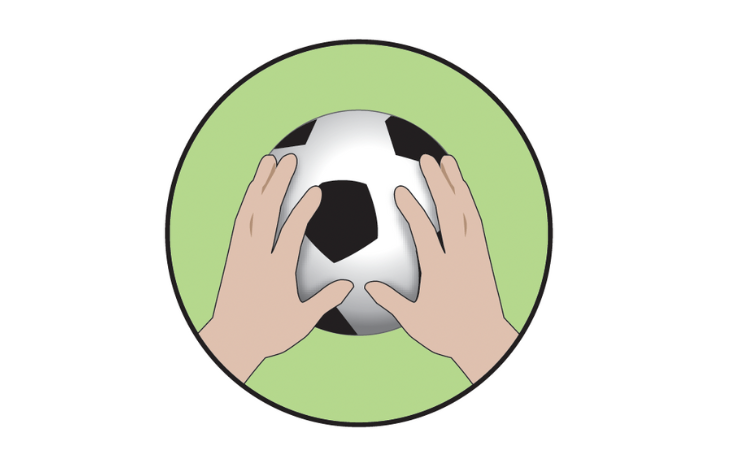
- Have index fingers and thumbs as close together as possible to form a ‘W’ shape
- Spread the fingers to hold the ball firmly
Related Files
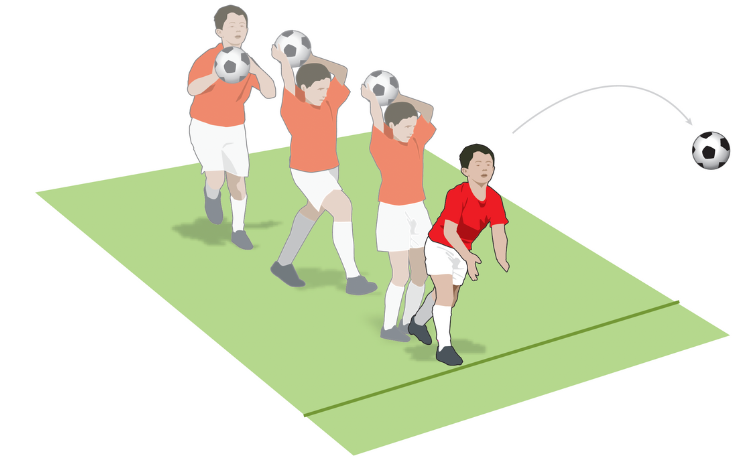
- Use both hands to throw the ball
- Have ‘loose’ arms, elbows bent and flared out
- Take the ball back past the ears
- Throw the ball from behind and over the head in a continuous motion, releasing it as it passes the front of the head
- Follow through with the throwing motion after the ball has been released
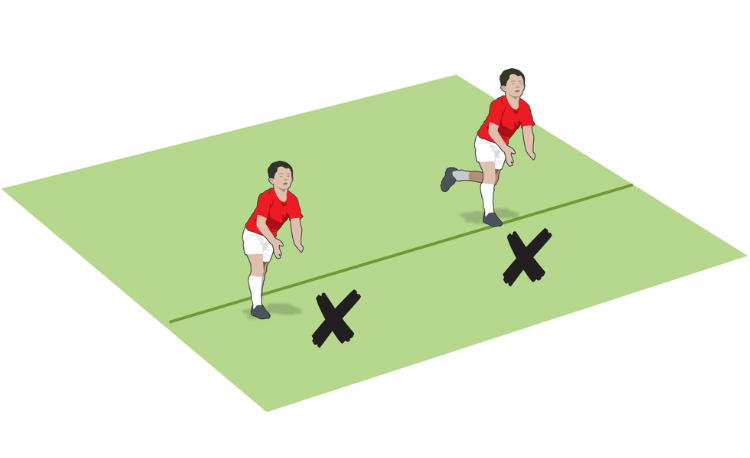
- Stay behind the line when throwing
- Keep both feet on the ground as the ball is released
Oh, and encourage players to give the ball a wipe before they throw it if it’s wet or muddy, or it may slip out of their hands!
Once players have mastered the technique of a throw-in, they may want to develop their throw-in skills by increasing the distance they can throw the ball.
At this point, they can be encouraged to:
- Lean back to make the throw more powerful
- Add a run-up before throwing the ball in
- Increase the speed of the arm movement when they throw.
As players develop further, consideration can also be given to:
- The area to throw the ball into
- Who to throw the ball to
- How to throw the ball to give the receiver the best chance of controlling it.
Practising throw-ins
When players are first learning to take throw-ins, they will need opportunities to learn and practice the technique.
This can be done simply by allowing two players to throw a ball back and forth.
For players that are struggling with the basic technique, you can break it down into parts, coaching the action with the hands and arms first, for example, before moving on to looking at keeping the feet on the floor.
Fun games can be used to help players practise their throw-in technique under time pressure.
For example, you may play a small-sided game where players throw rather than kick the ball, and the throws must be done with correct throw-in technique. This type of game is good for a warm-up activity.
When playing small-sided games in training, make sure to include throw-ins as part of the rules, and coach and correct technique as needed.
On matchdays, depending on the age and stage of your players, it may be that you can agree with the opposition coach and the referee to make an allowance for foul throws.
So, rather than a foul throw automatically resulting in possession being awarded to the opposition, the player that committed it might be given a second chance to take the throw, with some guidance from you or the referee, allowing them to learn and practise.
Who should take throw-ins
Every single player (even goalkeepers!) will take throw-ins over the course of their time playing the game, so they all need to be able to successfully execute the technique.
Sometimes, particularly at younger age groups, the player closest to the ball will take the throw-in.
This is done if teams want to take a quick throw-in – a tactic used to get the ball back into play swiftly before the opposition have a chance to get in shape.
This is a scenario where the goalkeeper, in the very rare circumstances where they are the nearest player, may be required to take one!
Often, at older age groups and in the bigger soccer formats, it is the full-backs who take the majority of the throw-ins.
The principle is that the left-back takes the throws on the left and the right-back does the same on their side.
Doing it this way allows a team to have more players in attacking positions, ready to receive the ball or join in with the play once the ball is back on the pitch.
Sometimes, teams may use their strongest thrower to take the bulk of their throw-ins, particularly for situations where a long throw-in may be of benefit – if it’s near to the attacking box, for example.

Soccer Coach Weekly
Latest Issue
Subscribe Today
Subscriber Testimonials

Gerald Kearney, Downtown Las Vegas Soccer Club

Paul Butler, Florida, USA

Rick Shields, Springboro, USA

Tony Green, Pierrefonds Titans, Quebec, Canada
Subscribe Today
Newsletter Sign Up

Coaches Testimonials
Gerald Kearney, Downtown Las Vegas Soccer Club
Paul Butler, Florida, USA
Rick Shields, Springboro, USA
Tony Green, Pierrefonds Titans, Quebec, Canada
Subscribe Today
Latest Issue

Discover the simple way to become a more effective, more successful soccer coach
In a recent survey 89% of subscribers said Soccer Coach Weekly makes them more confident, 91% said Soccer Coach Weekly makes them a more effective coach and 93% said Soccer Coach Weekly makes them more inspired.
*includes 3 coaching manuals
Get Weekly Inspiration
All the latest techniques and approaches


Soccer Coach Weekly offers proven and easy to use soccer drills, coaching sessions, practice plans, small-sided games, warm-ups, training tips and advice.
We've been at the cutting edge of soccer coaching since we launched in 2007, creating resources for the grassroots youth coach, following best practice from around the world and insights from the professional game.
