
 close
close


 LOGIN
LOGINYou are viewing 1 of 1 free articles
Lay the foundation for a love of soccer
Coach CONNOR McGINN tells STEPH FAIRBAIRN of his passion for inspiring the very youngest players, speaking their language and avoiding ’firefighting’



Connor McGinn is a 21-year-old coach based in the UK, FA Level 2 qualified and a third-year student in a football coaching degree programme.
He has spent time coaching at grassroots level, in development centres and at academies. Most of his coaching experiences have been with children from under-6 to under-10, and through that he has found a passion for coaching in the foundation phase (ages 5-11).
SCW caught up with Connor to talk about how we create the right environment at the foundation phase, the technical skills we should be coaching, how we can help our players shape their sessions, and what to bear in mind on matchdays when it comes to selecting a formation…
SCW: What is it about the foundation phase that appeals to you so much? What is it you think is so important about the phase?
CM: “The key is the word ’foundation’. You are laying the foundations for these children’s journeys so I think you need to ensure they are learning the key skills
"It’s [also a] love of the game. Certain coaches will coach kids at this age like they’re not kids, forgetting that they’re seven- and eight-year-olds, and their love of the game is shot for the rest of their lives.
"Ensuring they just keep loving football is so important at that age. It’s that love of football and that desire to learn that I love at this age, there’s no pleasure like it.”
SCW: How can we create an environment that is right for kids at that stage, and that fosters that love of the game?
CM: "I think it’s important to always remember they’re that age. Even within academy setups, remember these are seven and eight-year-olds. Their operating capacity is that of a seven or eight-year-old.
“It’s important to adjust your language and your coaching. If you’re trying to get across key technical detail, you need to do it in a way they will understand.
"I’ve seen coaches who will just shout ’movement’ and ’press’ at six-year-olds, who’ve never heard these terms before.
"You introduce press as ’chase’ or ’hunt’. Those are words children understand. It’s the same with ’space’ and ’movement’ - those terms need to almost be explained.
"That love of football, that desire to learn at that age, there’s no pleasure like it..."
‘Euphemism is big. For instance, when I’ve coached shielding and using your body, I’ve coached it to them as if they’re actually using a shield, like a knight. That’s something they can put in their heads and they love that.
"I think it’s so important to remember they’re children, and then think, ’okay, what did I understand as a child?’. If you’ve got kids yourself, what do they respond to?
"Always remember they’re children first, even before they’re footballers. You need to operate on that level."
SCW: What are the key things in this phase from a technical point of view?
CM: "I think it’s always important to have some kind of programme or thought in mind.
"It doesn’t have to be a very fancy periodised programme or syllabus, but having in mind six or seven key things you think children at this age need to learn in order to progress to the next phase.
“With my lads, it’s scanning, defending - which would include pressing - dribbling, passing, finishing, and receiving.
"Having those key elements stops a concept called firefighting. This is where you have a match, [and] the kids will do poorly in one area - let’s say their passing is poor.
"In the next training session, you’ll work on passing, and then their passing will be good but they’ll lack something else, then you go on to that. You’re just fighting what’s in front of you, and forgetting anything long term.
"Have a key plan that you stick to. It doesn’t have to be formal, it can even be notes on your phone where you say, ’I’ve got these six key areas, I’ll do them in two three week blocks’.
"So you do two three-week blocks on passing, on dribbling, on receiving - it helps keep it in a continuous way of development, so you’re not just fighting against how kids react on matchdays, you’re continuing their proper development.”
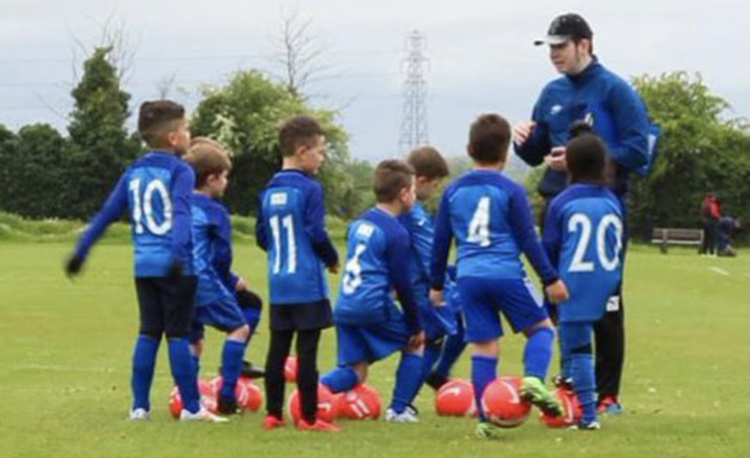
SCW: Part of working with youngsters is understanding the learning journey. Sometimes firefighting can come from a bit of panic about that. What would you say to coaches about how kids learn and progress?
CM: "A big problem related to this is matchdays. They should always be seen at this age as just an example to show off what they’ve learned.
"Results and individual performances are of little importance. At [ages] seven and eight, matches are for kids to love and learn.
"But what happens on matchday is never really consistently reflective of training. So I’d say don’t let matchdays affect your training.
"If you’re consistently thinking, ’okay, here are the five things I want to work on with my foundation-phase kids that I think they need to learn before they move up to the next age group’, don’t let matchdays change what those five things are."
SCW: How much should we be listening to children’s feedback on sessions - what they want from sessions, the kinds of activities they like, and essentially letting them shape our practice a little bit more?
CM: "It’s a balancing act. If you’ve ever coached seven-year-olds or eight-year-olds, the first question is ’when are we playing a match?’.
"If you were to just play a match every week without any constraints, you’re getting a lot of chaos, which can be beneficial to their learning. But equally, you’re getting an activity where their touches in a five-a-side will be a lot less than a 2v2 or 3v3 activity.
“Generally, smaller groups, more touches and high ball-rolling time are massively beneficial for kids. If you’re just playing a match each week, lots of key things, because of a lack of constraints, are missing.
"Smaller groups, more touches and high ball-rolling time are massively beneficial..."
"You can’t just go completely off what kids want, or even what adults want. Having said that, when you do an activity, no matter how good you think it is in your mind, if the kids aren’t enjoying it, what they’re getting out of it technically is going to be a lot lower.
“Take feedback at the end of the session. If their only feedback is ’I wish it had been a match’, that’s one thing. But if their feedback is ’coach, that went on for a bit too long’, or ’coach, I wish there’d been a goal at the end of that activity,’ take that on board."
SCW: Should we be building our formations based on our players’ strengths and giving them the opportunity to express themselves?
CM: "I have a U8s team at the moment who, because of their ability, play up an age group, so they play seven-a-side.
"I’ve tried out completely randomising positions, which I think is beneficial for versatility, but it can confuse them.
"What I’m doing now is blocks. In a four-week block of matches, each child will be assigned two positions. Then in the next block, they’ll be assigned two more.
"They’re learning different positions, but in a more controlled, consistent way. That idea came from my assistant. If you get yourself a really good assistant, your life’s much easier!
“Think about what formation is going to help teach them the most about football, is going to be most tailored to them, and isn’t going to be about winning you the game.
“If you are going to put them in a certain formation, do it in a way that’s most beneficial to the children, that will teach them roles, responsibilities and how to communicate and interact with each other."
Related Files

Steph Fairbairn
Latest Issue
Subscribe Today
Subscriber Testimonials

Gerald Kearney, Downtown Las Vegas Soccer Club

Paul Butler, Florida, USA

Rick Shields, Springboro, USA

Tony Green, Pierrefonds Titans, Quebec, Canada
Subscribe Today
Newsletter Sign Up
Coaches Testimonials
Gerald Kearney, Downtown Las Vegas Soccer Club
Paul Butler, Florida, USA
Rick Shields, Springboro, USA
Tony Green, Pierrefonds Titans, Quebec, Canada
Subscribe Today
Latest Issue

Discover the simple way to become a more effective, more successful soccer coach
In a recent survey 89% of subscribers said Soccer Coach Weekly makes them more confident, 91% said Soccer Coach Weekly makes them a more effective coach and 93% said Soccer Coach Weekly makes them more inspired.
*includes 3 coaching manuals
Get Weekly Inspiration
All the latest techniques and approaches


Soccer Coach Weekly offers proven and easy to use soccer drills, coaching sessions, practice plans, small-sided games, warm-ups, training tips and advice.
We've been at the cutting edge of soccer coaching since we launched in 2007, creating resources for the grassroots youth coach, following best practice from around the world and insights from the professional game.
