
 close
close


 LOGIN
LOGINYou are viewing 1 of 1 free articles
Learn lessons from 'Class of 92' legends
Grassroots clubs can take much from the way Manchester United nurtured the famous crop of youngsters that included David Beckham, writes IAN BARKER


How did academy coaches at Manchester United respond in the late 1980s and early 1990s when they realized the depth and potential of the group of players who would become the legendary ’Class of 92’?
David Beckham, Paul Scholes, Ryan Giggs, Nicky Butt and Phil and Gary Neville went on to be mainstays of senior United teams that won Premier League, FA Cup and European trophies, while Keith Gillespie and Robbie Savage - who started at United but thrived elsewhere - played in hundreds of top-flight domestic and international matches.
For the academy staff at this time, it would have been very reasonable to work toward FA Youth Cup glory. Such success would only propel the players’ careers and enhance the reputation of the academy and its coaches.
At the same time, I wonder if first-team manager Alex Ferguson was aware of the emerging talent and to some extent had a hand in shaping their development?
Were the players being moulded from an early stage into the style of play that defined Manchester United under Ferguson, so they could smoothly fit into the senior team?
Or was more of focus placed on each player’s functional responsibilities in their position? Were they simply being developed to win the games in front of them?
"If a coach is assured they have time to plan development, the benefits can be huge..."
A grassroots coach has similar questions to answer. There is no single approach to development - each coach must look at their environment, personal beliefs and abilities.
Beyond the imperatives of player safety and wellbeing, the development of youth players and teams can, and will, differ at all levels of the game.
One of the biggest challenges for the coach relates to time. If they have a good sense of how much time they will have with a group of players, they can plan better for sustainable development.
The importance of time is reflected both in the frequency of coaching contact in a weekly, monthly and seasonal cycle, and also the season-to-season development of players and the team.
If the coach is assured they have time to plan development and implement it, the benefits can be huge. If they also have good knowledge of what coaching the players and team received before coming to them, and what the expectations of them will be when they are passed on, intentional and sustained development can be assured.
MANCHESTER UNITED’S ’CLASS OF 92’
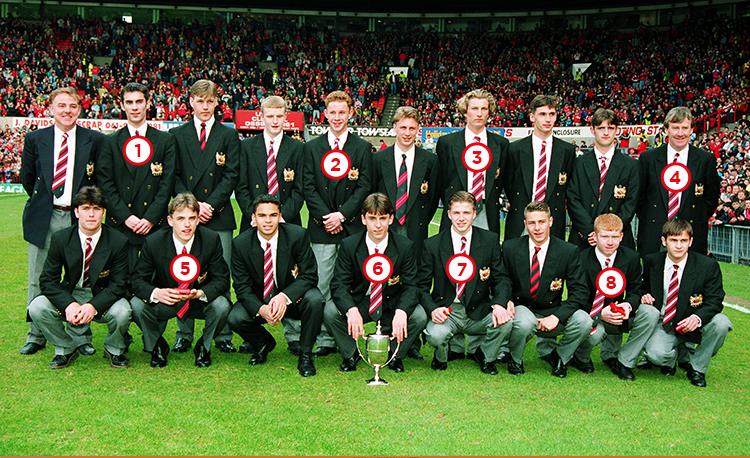
1. KEITH GILLESPIE Winger who made nine Premier League appearances for United before being sold to Newcastle in 1995 in the deal that brought Andy Cole to Old Trafford.
2. NICKY BUTT Holding midfielder, who played 387 times for United (1992-2004) and 39 times for England. Coached at the club between 2012 and 2021, including a spell as head of the academy.
3. ROBBIE SAVAGE Tenacious midfielder who never played for United but spent 11 seasons in the top flight with other clubs. Now a TV and radio pundit. Son Charlie is a United youth player.
4. ERIC HARRISON Manager of the United teams that won the FA Youth Cup in 1992 and 1995 and architect of the ’Class of ’92’. Died in 2019.
5. PHIL NEVILLE Full-back who made 386 appearances for United and played at Euro 2000 and Euro 2004 for England. Later managed the England Women’s team, now Inter Miami manager.
6. GARY NEVILLE Phil’s older brother, who played 602 times for United, mostly at right-back. Capped 85 times by England, he was part of the national team’s coaching staff and briefly managed Valencia. Now a high-profile TV pundit.
7. DAVID BECKHAM The face, and right boot, of United’s dominance of English soccer in the late 1990s and early 2000s, who became a global celebrity icon. After 394 appearances for United, his CV reads like a tour of fashion centres - Madrid, LA, Milan, Paris. Played 115 times for England, was captain for six years and scored in three World Cups.
8. PAUL SCHOLES Described by Xavi as "the best central midfielder I’ve seen in the last 15, 20 years" and by Andrea Pirlo as "a genius". A one-club man who scored 155 goals in 718 games for United. Briefly managed in England’s fourth tier.
For the grassroots youth coach, winning is always important. Where it is placed in the hierarchy of importance, however, is less certain.
Supporting the players’ enjoyment of the game and their desire to keep playing should be more important. Beyond this, each youth player needs to be developed individually, in terms of technique, tactics, psychology and physicality, then functionally, with a view to specific positional requirements, and ultimately for the perspective of fitting into a team formation and system.
In youth coaching, two-year windows of time with one coach and one team is a good rule of thumb. A youth coach may have a sweet spot of ability that makes them great with 11- and 12-year-olds, but less so with 9- and 10-year-olds or 13- and 14-year-olds.
Asking a coach, who is often a parent, to give up a team can be tough, but it is strongly encouraged that youth players get many coaching inputs. It is a strong model when the coach is working towards the time a team moves on from them.
In the US, recommended playing formats progress from 4v4 to 7v7 and to 9v9, before going to 11v11 at U13s.
When a club has a truly strong identity, there will be a preferred formation, system, style of play and even game model for the 11v11 teams.
As such, grassroots coaches working with the players in the other formats should be developing the players’ suitability as they progress through the formats.
Here is a hypothetical example. A club supports setting up teams in a 1-4-3-3, with one deep central midfield player. General principles are keeping possession, winning the ball high up the field, being defensively compact and attacking in wide areas. How does the coach of the U8s, for example, connect to this club vision while coaching 4v4?
While the U8s will have limited ability to grasp the nuance, a diamond formation could make sense. Thinking of the players in a #6, #8, #10 and #9 is a positive mindset and the notion of a central midfield triangle is established as well as that of a central striker.
When the team grows older, and they start playing 7v7, three players must be added. One would be the goalkeeper, the other two could be central defenders. Width will be less evident in 7v7 and the diamond is maintained and built upon.
At 9v9, the two further additional players will be a #2 or #7 and a #3 or #11. My preference is to think of these players as a #2 and #3, so they accept the defensive responsibility and can then enjoy attacking.
By the time they reach 11v11, the two new players would go into the flank positions and the 1-4-3-3 is completed.
In this example, assuming the players and club commit, understanding can be developed along a six-year path. Players can be trained in accordance with their individual abilities to fit into their club’s structure - and hopefully into other structures as any new club demands.
Sir Alex Ferguson, as he became after being knighted by Queen Elizabeth II in 1999, and his academy coaches at Manchester United had to shepherd young players as individuals and for the club’s benefit.
In many respects, the role of the grassroots coach is similar - and just as important to each young person as it will have been for the fledgling Beckham, Giggs et al.
Value what you do for youth players and take pride in your successes.
Related Files

Ian Barker
Latest Issue
Subscribe Today
Subscriber Testimonials
Gerald Kearney, Downtown Las Vegas Soccer Club

Paul Butler, Florida, USA

Rick Shields, Springboro, USA

Tony Green, Pierrefonds Titans, Quebec, Canada
Subscribe Today
Newsletter Sign Up
Coaches Testimonials
Gerald Kearney, Downtown Las Vegas Soccer Club
Paul Butler, Florida, USA
Rick Shields, Springboro, USA
Tony Green, Pierrefonds Titans, Quebec, Canada
Subscribe Today
Latest Issue

Discover the simple way to become a more effective, more successful soccer coach
In a recent survey 89% of subscribers said Soccer Coach Weekly makes them more confident, 91% said Soccer Coach Weekly makes them a more effective coach and 93% said Soccer Coach Weekly makes them more inspired.
*includes 3 coaching manuals
Get Weekly Inspiration
All the latest techniques and approaches


Soccer Coach Weekly offers proven and easy to use soccer drills, coaching sessions, practice plans, small-sided games, warm-ups, training tips and advice.
We've been at the cutting edge of soccer coaching since we launched in 2007, creating resources for the grassroots youth coach, following best practice from around the world and insights from the professional game.
