
 close
close


 LOGIN
LOGINMoving to seven-a-side: a rough guide
Under-10s coach MARK EDWARDS discusses the challenges and opportunities after switching up from five-a-side youth soccer, with SCOTT MOWBERRY
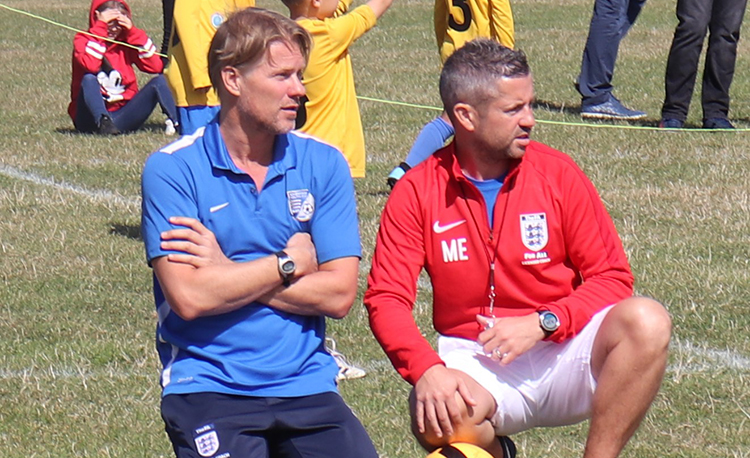
Like a large number of youth soccer coaches, Mark Edwards began life on the touchline when his son started playing.
Now, the Londoner has an FA Level 2 licence and is not only the Under-10s coach for Ickenham Youth Football Club, but also holds the title of youth development officer.
With his team, he has experienced the moves from five-a-side to seven-a-side, and recently from seven-a-side to nine-a side.
Each has presented its own challenges and opportunities, from ensuring equal playing time across a larger roster to introducing new and exciting concepts at training.
Mark spoke to his Ickenham coaching colleague Scott Mowberry - from our friends at the Soccer Coaching Podcast - about his coaching values, how he implemented them during the move to seven-a-side and what lessons he drew from the two formats…
SM: What is your current coaching philosophy and has it changed in the eight years you have been coaching?
ME: “I definitely think it’s changed a lot - not just the philosophy, but how I go about coaching and how a typical session would look.
"I actually documented my philosophy a couple of seasons ago. I think I had three points - one was around creating a positive environment, which is conducive for long-term player development and putting the player at the centre of the session.
"The second was about developing versatile players who were technically strong, comfortable with the ball in all areas of the pitch and able to make good decisions both in and out of possession.
"The last one, which I think was probably the most important for me, was designing fun training sessions where players are not afraid to try new things, and can make mistakes without any fear.
"If the sessions are not fun, then the boys or girls are not going to want to come back.
"My core values are a bit more streamlined. Number one was [to] be inclusive and treat all players equally, to the point where if someone came in, they wouldn’t know who my son was, if I’m coaching him.
"The second one is be prepared and organised, and finally work hard and always look to learn, which I think is really important when you’re a coach."
"Get it right at five-a-side, it makes the transition to seven-a-side straightforward..."
SM: What happens when a player has been told since they were six that they are a really good striker or goalkeeper and that’s all they have known for five or 10 years? Can you still promote versatility?
ME: "It’s so important to have that versatility and not pigeon-holing players at such a young age they don’t know how to play the other roles.
"As they get older, it gets harder to be able to do that - because, rightly or wrongly, it becomes more result focused.
"At that point, it’s hard for coaches to be able to play a player that can only play at the back in central midfield, or as a forward.
"The other thing to remember is that as you go through the older age groups, training gets a bit more tactically focused, and then a bit more position focused.
"So at U10s, U9s or U8s, you play a lot of small-sided games and don’t really have positions - or if you do, you rotate them.
"As they get older and it’s more tactical, then you probably have a bit more structure in terms of where players play, where their strongest position is, where they’re going to play on the Saturday or Sunday."
Be a more effective, more successful youth soccer coach
- Win more games, without sacrificing the crucial element of fun
- Develop every player, regardless of vast differences in ability
- Run a respected, professional programme - even with a full-time job and limited time
Subscribe for full access
Or register and unlock 2 free articles,
receive our weekly newsletter, and
get a FREE coaching e-book.
Or if you are already a subscriber login for full access.

Scott Mowberry
Latest Issue

Subscribe Today
Subscriber Testimonials
Gerald Kearney, Downtown Las Vegas Soccer Club

Paul Butler, Florida, USA

Rick Shields, Springboro, USA

Tony Green, Pierrefonds Titans, Quebec, Canada
Subscribe Today
Newsletter Sign Up
Coaches Testimonials
Gerald Kearney, Downtown Las Vegas Soccer Club
Paul Butler, Florida, USA
Rick Shields, Springboro, USA
Tony Green, Pierrefonds Titans, Quebec, Canada
Subscribe Today
Latest Issue

Discover the simple way to become a more effective, more successful soccer coach
In a recent survey 89% of subscribers said Soccer Coach Weekly makes them more confident, 91% said Soccer Coach Weekly makes them a more effective coach and 93% said Soccer Coach Weekly makes them more inspired.
*includes 3 coaching manuals
Get Weekly Inspiration
All the latest techniques and approaches


Soccer Coach Weekly offers proven and easy to use soccer drills, coaching sessions, practice plans, small-sided games, warm-ups, training tips and advice.
We've been at the cutting edge of soccer coaching since we launched in 2007, creating resources for the grassroots youth coach, following best practice from around the world and insights from the professional game.
