
 close
close


 LOGIN
LOGINStrength and conditioning for female players
Strength and conditioning training has become a must, even for non-elite teams. S&C coach Jeanne Rankin explains why it is particularly important for women.
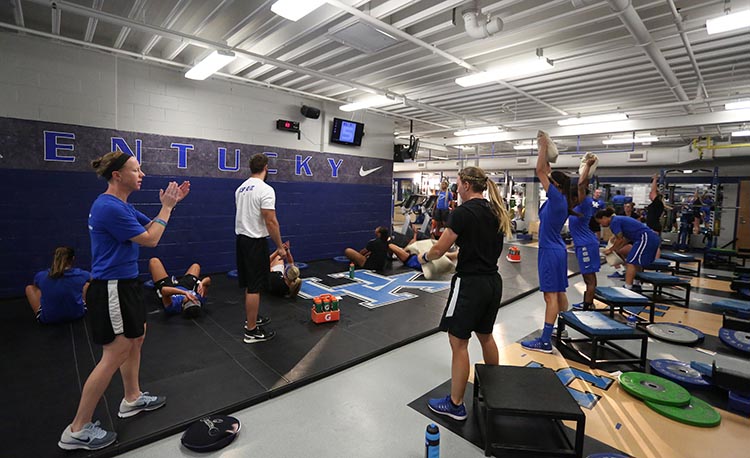
There is a wealth of information floating around about whether strength training is beneficial or harmful to soccer players.
I have heard it all from players and coaches over the years – ‘It will make us bulky and muscle-bound’; ‘it will make us slower’; ‘it will make us too tired for training and matches’; ‘it will make us sore and more likely to get injured’; ‘it will make us less flexible and mobile’; ‘we do not have time in the schedule for it’; ‘no-one understands the demands of soccer well enough’.
Some of these things could be true if you do not have a qualified strength and conditioning (S&C) professional working with your team – but it is generally quite the opposite if you have a well-rounded and collaborative approach.
The use of S&C with US college athletes really started with Boyd Epley at the University of Nebraska, whose American Football team was looking for a winning formula after a few mediocre seasons.
They employed Epley, who made their men bigger, faster, stronger, more agile and able to last longer, and the program completely turned around.
For those who believe muscle equates to being slower, look no further than the many American Football players who add 15-50lbs of weight during their freshman year of college and get faster.
Research indicates that increased muscle cross-sectional area equates to greater strength, and greater strength lays the groundwork for increased power.
"My main goal is to reduce risk of injury; my second is to improve athleticism..."
Additional benefits include increased range of motion and flexibility, being less prone to injury and quicker recovery.
Contrary to some belief, going through full range of motion movements in the weight room reinforces mobility and flexibility. More muscle around joints helps to stabilize them, which decreases the chance of injury.
Lastly, research supports the idea that increased strength helps with the body’s ability to recover quicker, which can be quite important in a sport like soccer.
When I am writing S&C programs for my teams, my main goal is to reduce injury risk. My secondary goal is to improve athleticism.
It is often the case that these go hand-in-hand, but it is always important to prioritize your goals.
The most common injuries in soccer occur in the knee, ankle, hamstrings, groins and head. While every athlete is unique, female players face a few different issues with injuries than males – women are more likely to suffer anterior cruciate ligament (ACL) tears, for example.
Let’s use the knee joint as an example of special considerations we should take into account while assessing injuries.
Women tend to have greater joint laxity than men. In the knee, this often comes in the form of hyperextension; a knee that hyperextends is more likely to be injured if the surrounding muscles are not strong enough to keep the joint from hyperextending during play.
Be a more effective, more successful youth soccer coach
- Win more games, without sacrificing the crucial element of fun
- Develop every player, regardless of vast differences in ability
- Run a respected, professional programme - even with a full-time job and limited time
Subscribe for full access
Or register and unlock 2 free articles,
receive our weekly newsletter, and
get a FREE coaching e-book.
Or if you are already a subscriber login for full access.
Latest Issue

Subscribe Today
Subscriber Testimonials

Gerald Kearney, Downtown Las Vegas Soccer Club

Paul Butler, Florida, USA

Rick Shields, Springboro, USA

Tony Green, Pierrefonds Titans, Quebec, Canada
Subscribe Today
Newsletter Sign Up


Coaches Testimonials
Gerald Kearney, Downtown Las Vegas Soccer Club
Paul Butler, Florida, USA
Rick Shields, Springboro, USA
Tony Green, Pierrefonds Titans, Quebec, Canada
Subscribe Today
Latest Issue

Discover the simple way to become a more effective, more successful soccer coach
In a recent survey 89% of subscribers said Soccer Coach Weekly makes them more confident, 91% said Soccer Coach Weekly makes them a more effective coach and 93% said Soccer Coach Weekly makes them more inspired.
*includes 3 coaching manuals
Get Weekly Inspiration
All the latest techniques and approaches


Soccer Coach Weekly offers proven and easy to use soccer drills, coaching sessions, practice plans, small-sided games, warm-ups, training tips and advice.
We've been at the cutting edge of soccer coaching since we launched in 2007, creating resources for the grassroots youth coach, following best practice from around the world and insights from the professional game.
