
 close
close


 LOGIN
LOGINYou are viewing 1 of 1 free articles
The importance of a 'family' environment
ROSS WHITE, U18s coach at English club Sutton United, tells STEPH FAIRBAIRN how he is creating a ’championship mentality’ among his budding professionals


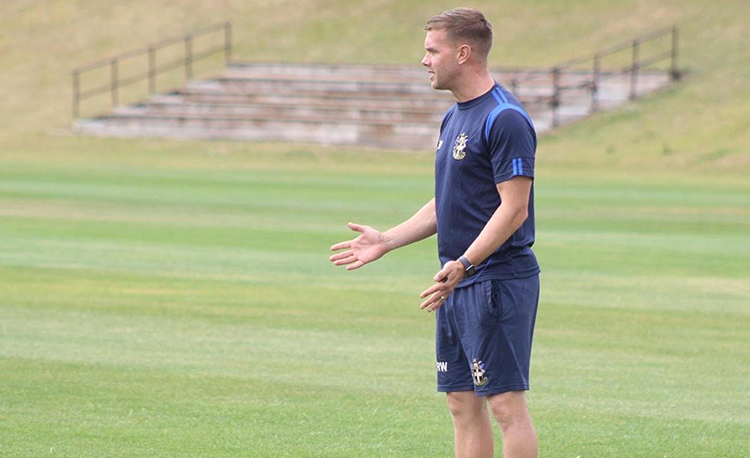
Having previously spent time coaching at QPR and Aldershot Town, Ross White is now lead professional development-phase coach at English fourth-tier club Sutton United.
The Sutton academy - where White leads the under-18s squad, the final step before the senior team - recently attained Category 3 status, the third level for UK academies.
Uefa A-licensed coach White describes the past 12 months at the club as "exciting times" and is now looking to develop what he calls a ‘championship mentality’ among his squad.
SCW caught up with White to talk about what that is, how he is going about developing it, and why getting to know your players is vitally important…
SCW: What is a ’championship mentality’?
RW: “Me and the guy I work with, Ian Palmer, looked at what we can do off the pitch and how it relates to on-the-pitch.
"We put a presentation together about building a ’championship culture’. I think everyone has different opinions on this and I don’t think there’s a right or wrong way. But we came up with what we think are the attributes to build that culture.
“Before going into the presentation, we gave the scholar boys a couple of days to think about a few questions. They came back to us and spent a couple of minutes speaking in front of the group about them.
"Some of the questions were: ’What does it mean to play for Sutton United at the level we’re at?’, ’What does it mean to be successful?’, ’What does success look like?’, ’What is your motivation?’. That started off the thinking for the players.
“Some boys were a little closed off, some boys really opened up. As a coach, I got to really know a bit more detail around the person, instead of the player.
“I think as soon as you’re interested in a person, the relationship starts to build between coach and player.
"We are with these boys every day. I probably see these players more than I see my family at the moment.
"To create that family culture around the U18s has been brilliant in terms of what goes onto the pitch.
"I think it needs to be backed up with what you’re doing day-in, day-out and the process of how you’re doing things.
"We are with these boys every day. I see these players more than I see my family..."
"That can be done in different ways, but I think it needs to be consistent. That eventually builds a culture.
"In six months’ time, I’d like to think we’re getting successes in the U18s. I would like to think that building this and being consistent with this will show us we’ve gone the right way with it.”
SCW: As the coach, how important is it to role model your values for the players to see?
RW: "It doesn’t work if you don’t live by them. There are three non-negotiables that we’ve asked as coaching staff.
"Firstly, relentless effort. Whatever we’re doing, we’ll go as hard as we can - we’ll train as hard as we can and leave everything out there. I want them to be okay with that.
"The second one we’ve got is competitive excellence. I’ve asked my boys to be the hardest-working team in our league, on and off the ball.
"If we didn’t get the result we wanted, if I can come off and say ’you outworked them’, I can take that. Again, I think that works off the pitch, as well.
“The last one is the power of the unit. If you’re on the pitch, you’re backing your teammates up, you’re working for each other.
"If a teammate is down because he made a mistake, build him back up. It’s creating that championship culture.
“They’re the three non-negotiables I ask the players to stick with. It’s not going to come after three weeks of pre-season. It’s for me and my coaches to make sure we’re consistent with the messages in training, in games and off the pitch.
"We created a leadership team led by our skipper, who put together their non-negotiables from what the players thought was the right thing to do.
"I think as soon as you do that, it’s their rules - they’re more likely to focus on staying within the boundaries or rules.
“We’ve got it on a template now. They’ve got ten, we’ve got three. I think if we can go by that consistently, day-by-day, we will be successful.
"Giving them responsibility and management of their rules works a lot better than me micromanaging it and saying these are the rules, stick to it.”
SCW: If someone is not necessarily behaving how they had agreed, does the leadership group hold them accountable?
RW: "I think the leadership group is massively important. It’s quite a good way for me to manage the group.
"If there’s a problem in the changing room, I challenge the skipper and the leadership group to fix the problem. That falls back into their development off the pitch.
“There are going to be situations where they will struggle and I’ll help them try to fix it. But if they’ve got a leadership group, they will set the standards and they will put out the small fires if they happen.”
SCW: How do you go about making sure you are weaving this mentality into everything that you do?
RW: "It needs to be consistently dripped in. When we’re having lunch, [it’s] making sure it’s left spotless, or better than when we found it, little things like that.
"We challenge our players to make sure they stay on point with stuff like that - being five minutes early for a meeting, making sure that you’re not letting your teammates down by being one minute late.
"If you can’t even get to a meeting on time, how are you supposed to rely on that person on the pitch? We always relate it to football.
“The way we coach, we’re tough on our boys but that does come with earning their respect first.
"What we don’t want to do is let anyone ride through the couple of years, then part ways and say, ’I sort of wasted it’. So we have to drive it every day.
"If they can’t get to a meeting on time, how can you rely on that person on the pitch?..."
“There are points where they slip up. That will happen at any academy, because they’re 16 and 17-year-olds. We’ve got to be realistic in terms of where they’re at. They’re not all going to be perfect.
"But that’s the great challenge of the coach; can you lead that group into being successful off the pitch and on the pitch?"
SCW: What’s the plan with this going forward? Is it something you’re going to review at the end of every season?
RW: "I’ll review it after three months, and I’ll probably do so again at the end of the season.
"I said to the boys, ’This is not just a presentation we do at the start of pre-season and forget about’. If the standards are not met in three months’ time, we’ll go through this again and go a slightly different way.
“It’s just about trial and testing. You might go, ’yeah, that works. I’ll keep that for next season’, or ’that doesn’t work, I didn’t get what I wanted out of that so I’ll take that out’. I’m quite happy to say that.
"Also, the new players that come in next year might react differently to what works and what doesn’t work. So you’ve always got to be moving, you’ve always got to be thinking outside the box, and just take it from experience."
Related Files

Ross White
Latest Issue
Subscribe Today
Subscriber Testimonials

Gerald Kearney, Downtown Las Vegas Soccer Club

Paul Butler, Florida, USA

Rick Shields, Springboro, USA

Tony Green, Pierrefonds Titans, Quebec, Canada
Subscribe Today
Newsletter Sign Up

Coaches Testimonials
Gerald Kearney, Downtown Las Vegas Soccer Club
Paul Butler, Florida, USA
Rick Shields, Springboro, USA
Tony Green, Pierrefonds Titans, Quebec, Canada
Subscribe Today
Latest Issue

Discover the simple way to become a more effective, more successful soccer coach
In a recent survey 89% of subscribers said Soccer Coach Weekly makes them more confident, 91% said Soccer Coach Weekly makes them a more effective coach and 93% said Soccer Coach Weekly makes them more inspired.
*includes 3 coaching manuals
Get Weekly Inspiration
All the latest techniques and approaches


Soccer Coach Weekly offers proven and easy to use soccer drills, coaching sessions, practice plans, small-sided games, warm-ups, training tips and advice.
We've been at the cutting edge of soccer coaching since we launched in 2007, creating resources for the grassroots youth coach, following best practice from around the world and insights from the professional game.
