
 close
close


 LOGIN
LOGINYou are viewing 1 of 1 free articles
Understand data's place in coaching
In his latest article for us, Fulham’s BEN BARTLETT explains how using the right figures - and ignoring the wrong ones - can complement your club’s direction


The previous nine articles in this 11-article series posed questions of coaches as to how they consider ‘what kind of club are we?’.
It has also explored how the decisions we make align with what is important within our environment, and provided some solutions we can all utilise in developing our players, our coaches - and ourselves.
Analysing how we are getting on can be a useful reflection of whether we are doing what we agreed we are committed to.
In this sense, generic, universal and arbitrary data points are possibly a dangerous place to start.
In 2015, I wrote two connected articles in The FA’s Boot Room magazine, discussing the importance of aligning the decisions we make to the commitments agreed.
This encompassed the whole human player development system, and analysis was a critical part of this alignment.
The articles encouraged coaches to analyse both how the team is learning to play with how we coach, and connect data collection to these commitments.
This was to support player development programmes to measure what they valued, rather than be seduced by the perception that data objectifies the game of soccer.
While data may provide some more objective reference points, it is very difficult - and possibly a fool’s errand - to attempt to completely objectify the game.
"Generic data can be misplaced if not aligned to the agreed intentions of the club..."
There are also problems with data points like expected goals (xG) and acute:chronic workload ratio (ACWR), which take different data points and, with a machine learning algorithm, distil them into a single number that seeks to determine whether or not a player should have scored, a team should have won or whether a player is likely to get injured.
These generic types of data collection, which the industry tends to use comparatively, can be misplaced if they aren’t aligned to the agreed intentions of any club, team or individual player.
There are also many other contextual factors that these algorithms find it challenging to consider. Being driven by a single data point - without considering the many contextual factors which data science can sometimes dismiss as being more subjective - can be risky.
While many experienced practitioners understand these contextual factors, and embed them into their coaching and development programmes, there is value in being purposeful in agreeing how we, more broadly, analyse how the players and the team are developing - aligned with what we are committed to - and the role our coaching plays in supporting this.
Previous articles have explored the integration of our playing approach with the individual players in our care, across their human systems, into our coaching. This particular one focuses on the analysis of this integration.
Data sits inside analysis, it isn’t alone. Coaches are increasingly working with people who have data scientist, performance analysis or insights roles to ensure their work is in harmony with the programme.
The first of my Boot Room articles from 2015 was entitled ‘Aligning Visions’. Linked to a Premier League club’s player-development programme, it focused on analysing the defending and pressing of our teams as a means of connecting our analysis to the ways the teams intended to play soccer.
As such, examining data points that connect to our intentions may be of value. The Passes Per Defensive Action (PPDA) metric was one we began to look more purposefully at, as a consequence of valuing pressing high and seeking to win the ball back early.
PPDA is calculated by dividing the number of passes allowed by the team out of possession, by the number of defensive actions.
A smaller PPDA value signifies a greater level of defensive or pressing intensity, as the defensive team has allowed a smaller number of uncontested passes to be made.
Teams that play a more passive style of play - defending nearer to their goal and then attempting to score with counter-attacks - may not see great value in a lower PPDA as their approach is, perhaps, less concerned about how intense their press is.
Similarly, a team who is down to 10 players, or who leads 3-0 and is happy to allow the opposition to have the ball and expend their energy, may also factor those critical contextual factors into their analysis.


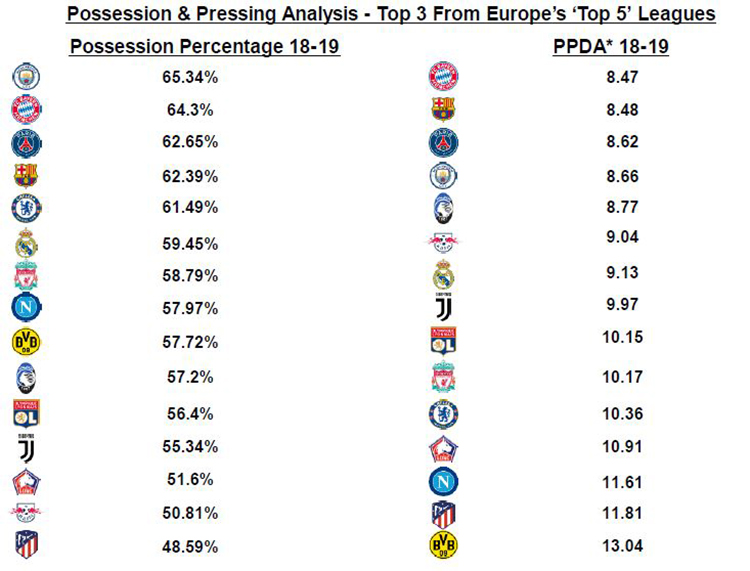
The image above shows, in the right-hand column, the PPDA value for the top three teams in Europe’s top five leagues (England, France, Germany, Italy and Spain) in the 2018-2019 season. This data point has been coupled with possession percentage statistics in the left-hand column.
While cursory, the intention is to connect an analysis of what these teams do with the ball, compared to what they do without it.
For example, Atletico Madrid - who have generated repeat finishes at the top of La Liga and gone deep into the latter stages of the Uefa Champions League on a number of occasions in the last decade - are known for playing counter-attacking soccer and defending aggressively near their own goal, rather than pursuing an early press.
This is perhaps the benefit in connecting different, associated data points as part of our analysis to seek to connect what we do with the ball with what we do without it.
The teams towards the top of both tables are those who have a low PPDA and a high percentage of possession.
If a team has a majority of possession, it possibly affords them the opportunity to have a lower PPDA. This can be a consequence of being able to press more intensely from positions of greater organisation and structure, enabled through controlling possession.
Similarly, connecting different data references can add additional context. A team that has a low PPDA (lots of attempts to win the ball back from the opposition) with a lower percentage of possession may be a team that works hard yet unsuccessfully to win the ball back.
Related Files


Further, if we want our team and players to be able to both press intensely and look after the ball when we win it back, we’ll need to train this across all of the human systems.
That is why the data references and broader analysis should be nested inside, and align with, the commitments we agreed underpin the type of club we are.
If we want our use of possession to be progressive and controlling, we may focus our attention on this.
Should we believe that an intense press, and a low PPDA, is important, then this might, at times, shift our attention to other aspects of the game.
Starting and finishing with the data points, though, is a little erroneous. We would be wise to analyse games more purposefully - either in the moment or in a recording - and, within this broader analysis, consider the following, linked to the PPDA data capture:
1. When we play different types of opposition, do we find it harder to successfully initiate our press? Teams that play with certain systems like a 3-box-3, or include brave players who are willing to carry the ball into and past pressure, may make it harder (or easier) to press intensely.
2. Does our team and player organisation impact our ability to press intensely? Playing different systems, or having different types of players in certain positions, can impact upon our defending.
Playing with a front two against two centre-backs might enable our press to be more intense than playing with a lone striker.
Additionally, players who are quick, powerful, able to sustain this over time or who have really good defending skills might support a better, more effective press.
3. Does the game state, or broader environmental conditions, impact our ability to regain the ball? Being behind and feeling the need to chase the game can lead to perhaps a less coherent pressing strategy, as can highly-charged atmospheres with perceived hostility or certain climactic conditions.
"A group of players unfamiliar with each other can impact team cohesion..."
A group of players relatively unfamiliar with each other can also impact team cohesion. This may occur in environments with a high numbers of injuries, or players leaving, joining or transitioning across age groups.
These constraints aren’t good or bad, positive or negative; just deeper aspects of the territory that is our experience.
Considering and factoring these deeper contextual elements into our thinking is an important part of the analysis that extends significantly beyond the numerical data.
Whatever our analysis uncovers across time should inform the evolution of our programme. This is one of the reasons why a pre-set, arbitrary syllabus synonymous with school is systematically mistaken.
It is very difficult to analyse what is going on and layer it into an evolving, responsive player-development programme if we have already decided, ahead of time, what is being coached on each day of the programme. What we have agreed is important is where we focus our attention.
This isn’t blindly retained or belligerently pursued. Our analysis can shape subtle shifts in our behaviour as we enable the evolution of the players’ development to emerge from the experiences we share.
If one of our central midfielders finds it challenging to recognise when to release in some of our pressing strategies, we layer additional elements of this into the games and sessions the players enjoy.
Further, when our press, inevitably, fails from time to time, and we end up outnumbered in deeper areas near our goal, this is a great opportunity for the players to be supported to learn some of the defending skills that are important when we are on the stretch and imbalanced.
Analysis of individual players might also focus on the things that are important to them and the development of their game.
Alongside, and in league with, the analysis of the team, there can be significant benefit garnered from observing, analysing and, if appropriate, generating some data on individual players. Connected and aligned with the broader development and training programme, this can deepen both player and coach understanding of progress.
Similar to the examples highlighted within the overall team analysis, this increased self-awareness can sharpen perception of the influence that different situations and opponents have on, for example, the aforementioned central midfielder.
This can then inform how we subtly constrain future experiences these players, and others, can be exposed to.
Focused individual analysis that genuinely connects with the nature of specific individual players can also trigger a more meaningful personal connection.
The feeling and attachment that more personal, individually responsive analysis promotes is a powerful purveyor, galvanising human relationships and appending immeasurable value.
This deepening of relationships can support us to connect the insights that we garner from our analysis to our practice.
Principally, that is why analysis exists - less so that coaches can ensure players can tell them what they should do in specific situations, and more to inform how we support and set up future experiences, enabling players to continue to learn.
There is no suggestion that the reader should combine the specific data points highlighted previously.
It might be we decide to align our commitment to pressing by measuring the number of final-third regains and synthesising this with how many final-third regains result in chances on goal, and goals themselves.
This can be done via notation rather than needing more sophisticated data capture and can help us to consider how frequently we win the ball back high and whether those regains lead to chances and goals.
"Analysing our own coaching can help us deepen awareness of what we do..."
Alternatively, we might measure and analyse some completely different things linked to the kind of club we are.
We might measure smiles, laughs, and positive interactions that occur between our players and the coaches. These are all things we can encourage, demonstrating and developing their value in our environment.
Considering how we then analyse whether our coaching programme is delivering what we agreed acts as an additional layer of self-analysis as to whether we are helping the players to be able to do the things we collectively agreed are important.
My second article in Boot Room focused on this. Analysing our own behaviour and coaching approach can support us to deepen awareness of what we do.
We can collect information on the programme we deliver, connect it to the things the players have agreed are important and combine it with the way we feel about our coaching sessions.
Many academic institutions have promoted the notion of measuring coaching behaviour. As yet, few have connected what is measured to what is valued in a particular context.
Instead, it has frequently lead to generic coding and standardised, often comparative, data collection of coach behaviour. Perhaps it would be better if these approaches support coaches to generate reflection strategies that are unique, individual and responsive.
This isn’t a lowering of standards, more an empowering of each coach and group of players to establish and commit to the highest of standards.
However, these aren’t ‘standard’, universal or lifted from somewhere else. They are ours, we own them - ensure we enable them to drive us forward and hold ourselves to account in alignment with them.
We are not comparing whether we are better or worse than someone else; rather, focussing on bettering ourselves and harmonising our cares to the judgements we make as to how we are getting on.
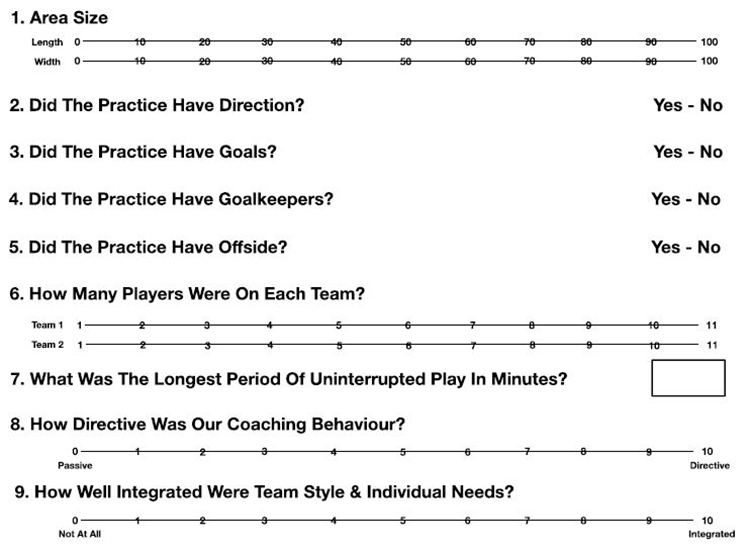
The nine questions in the reflection form (above) are an example of some ways we might review our practice sessions, in alignment with some of the principles raised throughout these articles.
The principles highlighted in this reflection tool align to things that I, personally, value. They are used to focus attention on the importance of measuring what we value.
While these questions may not align with your context, establishing a reflection and analysis method that aligns with the beliefs of your environment can generate at least the following three benefits:
Firstly, on a sessional basis, it will enable us as coaches to analyse what we did and whether it was what we and the players wanted or needed.
Secondly, across longer periods of time like half-terms, seasons and whole player development journeys, it will help support us to analyse the broader diet of practice that players have been exposed to.
If, for example, we reflect that our players aren’t very good at managing the ball in tight areas, we may consider the amount of exposure the players have been given to small pitches.
Further, if the players aren’t good at timing runs to stay onside - and we rarely include the offside law in our games - then that might be something to think about.
It may also be that this illuminates any blind-spots we have in our coaching repertoire. These may include stopping practice sessions frequently or a tendency when using larger number games to not influence individual player needs as readily.
This synthesis of our coaching behaviours can contribute positively to our own development and that of our players.
"Reflection may illuminate any blind sports we have in our coaching repertoire..."
Finally, the reflection tool is an opportunity to connect the analysis of our coaching behaviour to the way the team and the individual players play on matchdays, as encouraged in the opening part of this article.
Are there certain approaches that may impact positively on the ways the team play come gameday, or which certain players share that they respond well to?
A combinatory approach of this nature can support a session that had brilliant energy, emotion and feel but perhaps was misaligned with some of our other intentions to be valued for the positivity it elicited.
Generate your own reflection tools that are a reflection of what is important to you and the people in your environment.
Connect these reflections across time and retain a reminder of what the players have experienced in previous seasons or iterations of our player-development programme.
Not all analysis needs to focus on data and objectification.
Human beings sense, feel joy and mirror the emotions of others. We are lifted or affected by kindness, consistency and warmth. This sense and feel is often what attracts people to soccer and the personal connection it promotes.
Data is increasingly a constituent part of our eco-systems and should be embraced and seen as supportive of our collective growth and development.
However, so many of the emotions that soccer elicits are very difficult to condense. Attribute value to and ‘measure’ this too - even if we can’t pin a number to it.
Latest Issue

Subscribe Today
Subscriber Testimonials

Gerald Kearney, Downtown Las Vegas Soccer Club

Paul Butler, Florida, USA

Rick Shields, Springboro, USA

Tony Green, Pierrefonds Titans, Quebec, Canada
Subscribe Today
Newsletter Sign Up
Coaches Testimonials
Gerald Kearney, Downtown Las Vegas Soccer Club
Paul Butler, Florida, USA
Rick Shields, Springboro, USA
Tony Green, Pierrefonds Titans, Quebec, Canada
Subscribe Today
Latest Issue

Discover the simple way to become a more effective, more successful soccer coach
In a recent survey 89% of subscribers said Soccer Coach Weekly makes them more confident, 91% said Soccer Coach Weekly makes them a more effective coach and 93% said Soccer Coach Weekly makes them more inspired.
*includes 3 coaching manuals
Get Weekly Inspiration
All the latest techniques and approaches


Soccer Coach Weekly offers proven and easy to use soccer drills, coaching sessions, practice plans, small-sided games, warm-ups, training tips and advice.
We've been at the cutting edge of soccer coaching since we launched in 2007, creating resources for the grassroots youth coach, following best practice from around the world and insights from the professional game.
