
 close
close


 LOGIN
LOGINYou are viewing 1 of 1 free articles
'We don't focus on keeping possession'
Crewe Alexandra Women’s coach MATT FISHER talks to STEPH FAIRBAIRN about taking the game to opponents and breeding confidence in his players


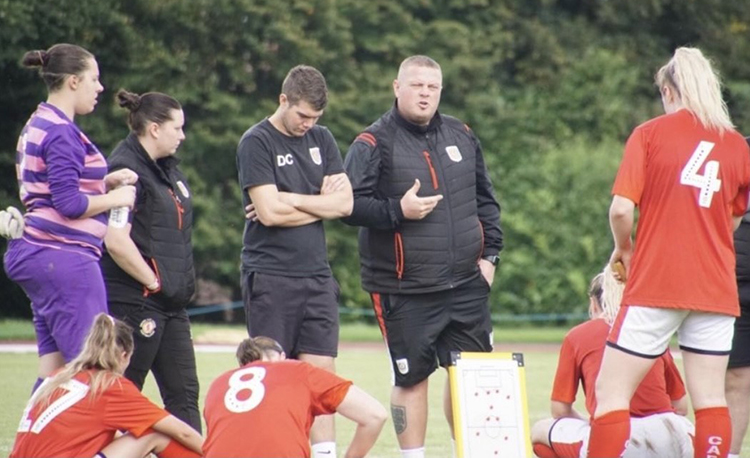
Having stepped away from coaching to become a postal worker, an offer to coach a colleague’s son’s soccer team led Matt Fisher back to a journey he had started at the age of 16.
More than two decades on from his first step onto the coaching ladder, Matt is now full-time at English pro club Crewe Alexandra, famed for their academy which has produced several England internationals.
He works with the U18s boys on the education programme, leads on the newly formed Emerging Talent Centre, and manages the women’s first team.
SCW caught up with Matt to talk about his work with the women’s team, the style he’s developed and what working with his first female team has taught him as a coach...
SCW: Let’s talk about your role at Crewe. Tell us a bit about your philosophy and what you are building there...
MF: “When it started, the women’s section wasn’t really part of the club. It was a standalone club that used the name Crewe Alexandra.
"I had no history in women’s football. I’d worked in boys’ football, men’s football, academy football, non-League football, disabled football and mentoring.
“It was just a bit of luck, really, that I went in at the time where the club was looking at getting more involved with the women’s section, and it came under the club’s banner.
“Early on, from all the coaching staff and players, equal opportunity was a big thing. If a U9s boys’ team is getting a team bus, or physiotherapy, then the girls should be getting the same.
"We changed from training once day a week to two days a week, which is a massive commitment. We’ve got single mums that are at university, NHS staff [health workers] and police officers, so that commitment has been key.
"We’ve had to let players go who wanted something where they could turn up and have a kickabout. That’s helped us recruit the right type of player.
"The women’s section mirrors the boys section at Crewe. A lot of people know about Crewe Alexandra as a men’s team. We don’t have lots of money to throw around, we have to produce our own talent.
"I’ve had to reassure players a bit more...the real pleasing thing is the will to learn..."
"The syllabus the women work from is exactly the same one the academy boys use, and that I use with our under-18 scholars, to try and produce a Crewe Alexandra footballer, whether it be a boy or girl.”
SCW: What, for you, have been the key differences between coaching a male team and a female team?
MF: "From a psychological point of view, the girls require more information and kind of worry if they are not doing something correct, or if there’s a change in the team.
"I felt like I’ve had to reassure players a bit more than I’ve done in the men’s game - some girls think they’ve done something wrong when they haven’t.
“The real pleasing thing is the will to learn. You go into certain environments in the men’s game, there can be big egos and sometimes they don’t want to learn.
"Technology can sometimes be scoffed at, whether it be a Veo camera or GPS vests. Whereas in the female game, a lot of the time they haven’t really benefited from that, so any kind of technology or information you give them, they lap it up.
“As a coach, that’s really what you want. You want to work with players that want to learn. I can’t see me leaving in the female game now."
SCW: Tell us a bit about your playing style and what your team’s brand of football is...
MF: "When I went in, we knew we had to improve our athleticism. I wanted them to win the ball back as early as possible, get at opponents and ask questions, whether that be through a sequence of passes, a phase of play, or 1v1s.
"I always say to our players, if you’re out numbered, 2v1 or 3v1, then by all means recycle possession. But if you’re 1v1, you should be getting at that player and asking questions.
"We don’t focus too much on keeping the ball. I don’t think we’d get excited by the fact we had 70% possession - it’s more about creating key chances.
"Sometimes that is through possession. We played a team on Sunday that sat quite deep and were required to move the ball around much more than we would normally to try and draw them out.
"But most teams will come at you and that gives you opportunities to find space in behind and be quite intense.”
SCW: That approach requires confidence. Some in the female game have said that is something they have to work on more with female players. How do you go about building up confidence?
MF: "It’s something I’m learning. We have a player that really doesn’t know how good she is. I say to her every time, ’get at the player’ and she’ll do it regularly in training.
"She’s well-known in the league, players are scared of her. Sometimes I think she takes an easy option and it is purely because she thinks ’What if I lose possession?’. But when you’re in the final third of the pitch, the risk is really low and the reward is so high.
"I would never tell them off for losing possession in the final third - I’m only upset when they just palm it off to a central midfielder, because if I was that full-back, the last thing I would want is her running at me. She really is a beast of an athlete.
“So sometimes it’s reassuring the player of what they can do - ’Do you remember when you did this against this team? That’s exactly what we want, it worked that time’.
SCW: What does your planning and preparation look like for match days?
MF: "When I first came in, the girls weren’t told the starting 11 until half an hour before kick off. That shocked me a little.
"Previous coaches were a bit concerned that if a girl finds out she’s on the bench, would she turn up? If a girl doesn’t turn up, it’ll be the last time she plays for me. And it’s not something we’ve ever had an issue with.
"We don’t focus too much on keeping the ball - it’s more about creating chances..."
“So the squad will go out on a Friday. That allows any girls that aren’t in the starting 11 to get over that disappointment.
"If I feel the opponent’s best player is, say, a left winger, I might text the right-back on Saturday and say, ’How are we’re going to cope with her tomorrow?’. Just engage in conversation, and provoke a bit of thought.
“On matchday, I used to find I fell into the pit that a lot of coaches do, getting so involved you take each loss so personally.
"I’m not so bad any more. I try to treat it like a coaching session. In the first 10 minutes, we’ll rarely say anything. I don’t feel like anybody can benefit from anything within the first 10 minutes. It has to settle.
“At half-time, the coaches will stay outside the dressing room for five minutes. It allows us to have a little discussion and make sure we’re all singing off the same hymn sheet."
SCW: If you could give one takeaway point to a coach, what would it be?
MF: "A mentor of mine said, ’Don’t let your professional standards drop. Be professional in everything you do’.
"I benefited from some really good mentors, but almost ended up trying to be a carbon copy of them. As I’ve got a bit older, I’ve learned to take the best bits of them but still be me.
"That’s probably the best bit of advice I can give - take everything good from the people you work with, but don’t lose you."
Related Files

Steph Fairbairn
Latest Issue
Subscribe Today
Subscriber Testimonials

Gerald Kearney, Downtown Las Vegas Soccer Club

Paul Butler, Florida, USA

Rick Shields, Springboro, USA

Tony Green, Pierrefonds Titans, Quebec, Canada
Subscribe Today
Newsletter Sign Up
Coaches Testimonials
Gerald Kearney, Downtown Las Vegas Soccer Club
Paul Butler, Florida, USA
Rick Shields, Springboro, USA
Tony Green, Pierrefonds Titans, Quebec, Canada
Subscribe Today
Latest Issue

Discover the simple way to become a more effective, more successful soccer coach
In a recent survey 89% of subscribers said Soccer Coach Weekly makes them more confident, 91% said Soccer Coach Weekly makes them a more effective coach and 93% said Soccer Coach Weekly makes them more inspired.
*includes 3 coaching manuals
Get Weekly Inspiration
All the latest techniques and approaches


Soccer Coach Weekly offers proven and easy to use soccer drills, coaching sessions, practice plans, small-sided games, warm-ups, training tips and advice.
We've been at the cutting edge of soccer coaching since we launched in 2007, creating resources for the grassroots youth coach, following best practice from around the world and insights from the professional game.
