
 close
close


 LOGIN
LOGINWhat is a formation?
From a simple 1-2-1 at five-a-side to complex strategies at the elite level, Steph Fairbairn explains the basics behind choosing, and then using, a team shape.
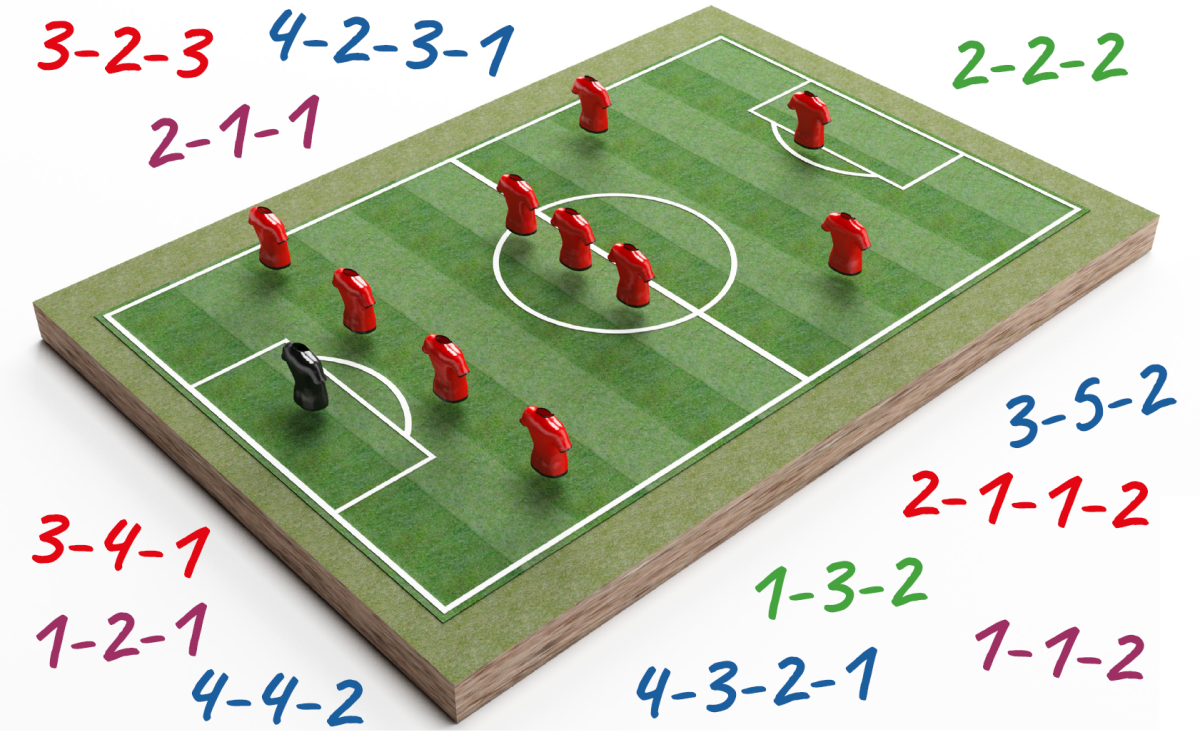
A team’s formation is the way they set up on the pitch.
It describes the shape that they play in and the position the players take in relation to each other.
Of course, soccer is a fluid game in which players move around the field. A formation gives teams and players some guidance as to how they might move and what their duties are, both when attacking and defending.
The presentation of formations
You will often see formations denoted as numbers.
For example, in the 11-a-side game, teams may opt to play a 4-4-2 - that is four defenders, four midfielders and two attackers - or 4-3-3, which is four defenders, three midfielders and three attackers.
Usually, the numbers don’t include the goalkeeper, just all of the outfield players, and always go from the players furthest back to the players furthest forward.
However, you may hear some coaches, particularly in youth soccer, include the goalkeeper as a ’1’ before the rest of the formation. This is often done to promote inclusivity around the role of the goalkeeper. Here, though, we will stick with the most common format throughout.
"A formation gives players guidance as to their attacking and defending duties..."
Some formations might require four numbers: for example, 4-2-1-3. This indicates there are four defenders, two defensive midfielders, one more attacking midfielder, and three forwards. This could, however, also be called a defensive 4-3-3.
Some may use five numbers. 4-1-2-1-2 is an example. This indicates four defenders, one defensive midfielder, two central midfielders, an attacking midfielder and two attackers. This could also be called a 4-4-2 diamond.
The word ‘diamond’ refers to the shape the midfielders make when in their starting position.
How to choose a formation
All formations have their different pros and cons.
Some formations may mean you have more capabilities in defence – for example, in 11-a-side, a formation with four defenders, rather than three. Some may lend themselves more to wide play when attacking, while others may promote more attacks through the middle.
At the elite level, where it’s about winning games and getting points on the board, formations are chosen to allow for the strongest possible team to play, or to match up with, or cancel out, the threat of the opposing team.
Be a more effective, more successful youth soccer coach
- Win more games, without sacrificing the crucial element of fun
- Develop every player, regardless of vast differences in ability
- Run a respected, professional programme - even with a full-time job and limited time
Subscribe for full access
Or register and unlock 2 free articles,
receive our weekly newsletter, and
get a FREE coaching e-book.
Or if you are already a subscriber login for full access.

Steph Fairbairn
Latest Issue

Subscribe Today
Subscriber Testimonials

Gerald Kearney, Downtown Las Vegas Soccer Club

Paul Butler, Florida, USA

Rick Shields, Springboro, USA

Tony Green, Pierrefonds Titans, Quebec, Canada
Subscribe Today
Newsletter Sign Up
Coaches Testimonials
Gerald Kearney, Downtown Las Vegas Soccer Club
Paul Butler, Florida, USA
Rick Shields, Springboro, USA
Tony Green, Pierrefonds Titans, Quebec, Canada
Subscribe Today
Latest Issue

Discover the simple way to become a more effective, more successful soccer coach
In a recent survey 89% of subscribers said Soccer Coach Weekly makes them more confident, 91% said Soccer Coach Weekly makes them a more effective coach and 93% said Soccer Coach Weekly makes them more inspired.
*includes 3 coaching manuals
Get Weekly Inspiration
All the latest techniques and approaches


Soccer Coach Weekly offers proven and easy to use soccer drills, coaching sessions, practice plans, small-sided games, warm-ups, training tips and advice.
We've been at the cutting edge of soccer coaching since we launched in 2007, creating resources for the grassroots youth coach, following best practice from around the world and insights from the professional game.
