
 close
close


 LOGIN
LOGINHow to manage 3v3 match days
If your U7 team are set to begin their 3v3 season come the summer or autumn, here’s how you may go about approaching matchdays.



3v3 matchdays are not competitive events, rather they are opportunities for players to play, get lots of touches on the ball, make lots of decisions, begin to learn about how the game works and, perhaps most importantly, have fun.
Extensive research has shown that the 3v3 format encourages more physical activity and increases the number of technical actions, meaning 3v3 games should be action-packed and allow players to express themselves on the ball.
In order to allow your players to get the most out of a 3v3 matchday, you should consider doing the following.
Have a plan
The 3v3 format works in the following way:
- You create as many 3-a-side teams as possible from the number of players you have available for matchday
- These teams then play against teams from another club who have split their players the same way
- There are number of fixtures on matchday, each lasting six to ten minutes, with players playing a maximum of 40 minutes in total
- Fixtures should run at the same time
- There are no substitutions, meaning each player plays all of the time
- There should be one adult per pitch – this adult is not a referee, rather just a facilitator helping children to make their own decisions safely
In order to plan for each matchday, you need the answers to the following questions:
- How many players will you have? How many teams will these players be divided into?
- How many players will your opponent have? How many teams will these players be divided into?
- How many fixtures will be going on at once? How many pitches are therefore needed? And, give it’s one adult per pitch, how many adults are needed? And how will you organise this with your opponent?
- Which teams will play which? Or how will you rotate teams around the pitches?
- What will the game timings look like? How long will each game be and how long is the break in between each fixture?
Set up early on the day
If you are running multiple fixtures on multiple pitches, there will have to be a bit of set up in terms of touchlines and goals. Get there early to allow you to do all of this before the players arrive.
If feasible, it might also be an idea to assign pitch numbers or names, and make these clear, and share a mini schedule or plan to help teams move between their fixtures.
Pitches should be next to each other which allows for a fun, gameday experience for all, and means adults can have oversight of everything.
Make sure you’ve got your equipment
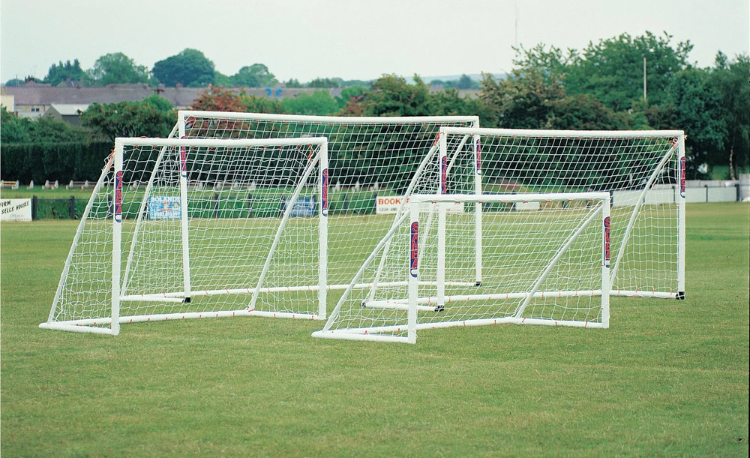
Key pieces of equipment are cones and/or flat markers for pitch set up, mini goals if you have them (though cones can be used if needed) and enough balls for all of the pitches.
You’re also very likely to need sets of bibs in a few different colours, given that your players will probably all be in the same kit and may end up facing each other.
Be flexible
The 3v3 format is designed to be flexible and it’s on us as coaches to make it so. Remember, the objective is as much playing time as possible for every player.
Only got three players available? Great, play with one team! Got 12 players available? Play with four teams. Got 10? Have two teams of three and one team of two. The two will then learn how to play underloaded.
You’ve got five players and your opponent has 11? Mix the squads up. You’ve got 12 and your opponent has 6? You’ll likely have to play your own teams.
Whatever the situation, making it work for the players and getting games going is the priority.
Let them play
Each adult facilitator is not there to referee, or over-coach. Teams don’t need any formations, strategies, or tactics. They just need themselves, a pitch and a ball.
Facilitators are there to make sure the space is safe, allowing players to manage their own game, enjoy it and express themselves.
All you should be providing to players is any clarity on the rules, should they need it (though don’t get bogged down in that, it’s not that important), and lots of positive encouragement – whether the players are yours or from the other team.
Set expectations
Make sure players and parents know what the approach is about ahead of time. You’ll definitely need parental support – that’s lots of cheering and positive encouragement for all – so let them know that’s what you’re expecting, and that they can expect to be challenged should the provide something different.
Start and finish games the right way
Each game should start with high fives between all of the players, showing respect and sportsmanship.
A fun game like ‘Rock, paper, scissors’ or ‘Guess what hand the grass is in’ should then be used to decide who gets kick off at the start of the game.
After the game, players should shake hands or offer more high fives.
Get parents involved
You might be wondering how you’re going to be able to have an adult facilitator per pitch. You’ll likely need to get some parents involved to do that job. Make sure they understand what their role is and support them with it as needed.
Split teams differently each week
Make up different threes, or twos, on each matchday, rather than having consistent groups. This will allow players to make new friendships, and experience playing with all different types of players, broadening their experience of the game.
Enjoy it!
This is the start of a player’s matchday experience, and hopefully something that will only serve to build their love of the game. How cool is it that you get to be a part of that? Make sure you enjoy it as much as you want your players to!
RELATED


Related Files

Latest Issue

Subscribe Today
Subscriber Testimonials

Gerald Kearney, Downtown Las Vegas Soccer Club

Paul Butler, Florida, USA

Rick Shields, Springboro, USA

Tony Green, Pierrefonds Titans, Quebec, Canada
Subscribe Today
Newsletter Sign Up

Subscribe Today
Latest Issue
Discover the simple way to become a more effective, more successful soccer coach
In a recent survey 89% of subscribers said Soccer Coach Weekly makes them more confident, 91% said Soccer Coach Weekly makes them a more effective coach and 93% said Soccer Coach Weekly makes them more inspired.
*includes 3 coaching manuals
Get Weekly Inspiration
All the latest techniques and approaches


Soccer Coach Weekly offers proven and easy to use soccer drills, coaching sessions, practice plans, small-sided games, warm-ups, training tips and advice.
We've been at the cutting edge of soccer coaching since we launched in 2007, creating resources for the grassroots youth coach, following best practice from around the world and insights from the professional game.
