
 close
close


 LOGIN
LOGINYou are viewing 1 of 1 free articles
How to warm up your older youth players before a match
Carl Wild’s guide to getting sharp for games and preventing muscle injuries.



As children progress towards adulthood, their bodies change and develop.
It is at this stage, usually from around the U12s age group, that they become more vulnerable to muscle injuries.
Therefore, the need for them to warm up effectively before a match is greater. This involves introducing dynamic stretching to warm-up routines.
A good warm-up will achieve the following for older age groups:
- Get players moving in the way that they will during the game
- Be fun and engaging, something that you know players enjoy, and get them excited for the game ahead
- Give players routine and structure
- Encourage leadership and ownership
- Not tire players out – around 20 to 25 minutes should be sufficient to set them up for their game
- Be quick and easy to set up, making things more manageable for the coach on a day when they already have lots to do
- Not require a lot of coach intervention
- Allow players to experience having the ball at their feet, so the first time they do it isn’t during the match itself
- Work for any number of players – allowing players to drop into it as and when they arrive
- Incorporate dynamic stretching, preparing their muscles for the game ahead.
Often, we take dynamic stretching to mean players in lines of two and three, following each other while going through a sequence of stretches.
While doing it this way has its advantages, what we can sometimes forget to do is asking the players to warm up before they stretch.
Warming up increases blood flow to the muscles, which then helps them become more flexible and less prone to injury when stretched.
There are three low intensity practices we recommend that can be used either before the players complete their stretches, or to integrate their stretches into.
1. ’Gates’
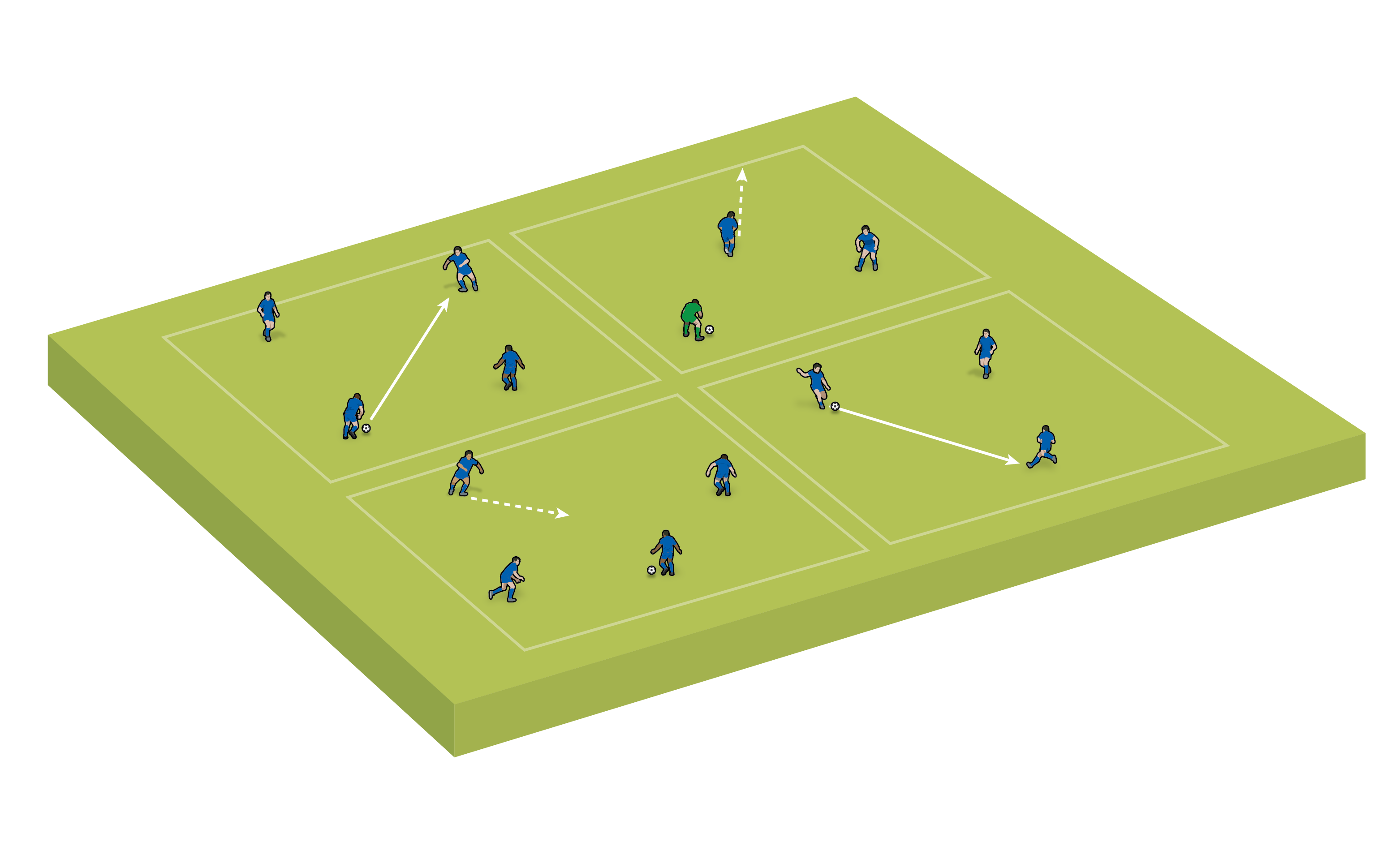
Using gates within an area is a simple activity that can be set up really quickly with the help of the players.
Once the area has been set out, using just four cones – one for each corner – we can get the players to grab two cones apiece and use them to create the gates.
Then, it’s just a matter of adding in a few balls and getting the players to travel through a gate after they have played a pass.
The intensity of the warm-up can easily be increased by changing how the players travel through the gate.
This includes getting them to complete dynamic stretches.
For example, they can begin by jogging through gates, before moving on to completing other similar movements, such as side steps or running backwards. Then, after a short amount of time, we can introduce dynamic stretches.
Finally, they can return to jogging through the gates again, before the intensity is fully increased and they finish off the activity by sprinting through the gates.
2. ’Carousel’
Using a carousel approach introduces stretches through a familiar format.
Within each of the different carousel stations, the players perform a different task – in this case, one or two of these would be to complete a dynamic stretch.
However, one tweak to the more traditional carousel format is that, before the players start the tasks specific to the station they are starting in, they all need to complete the same action.
This is so their bodies go through the first stages of a warm-up, before they participate in more intense activities as well as the stretches.
They could all begin by passing a ball and moving around their practice areas, for example, before transferring into their individual station activities, which could include a rondo, a 1v1, and some dynamic stretches.
3. ’Handball’
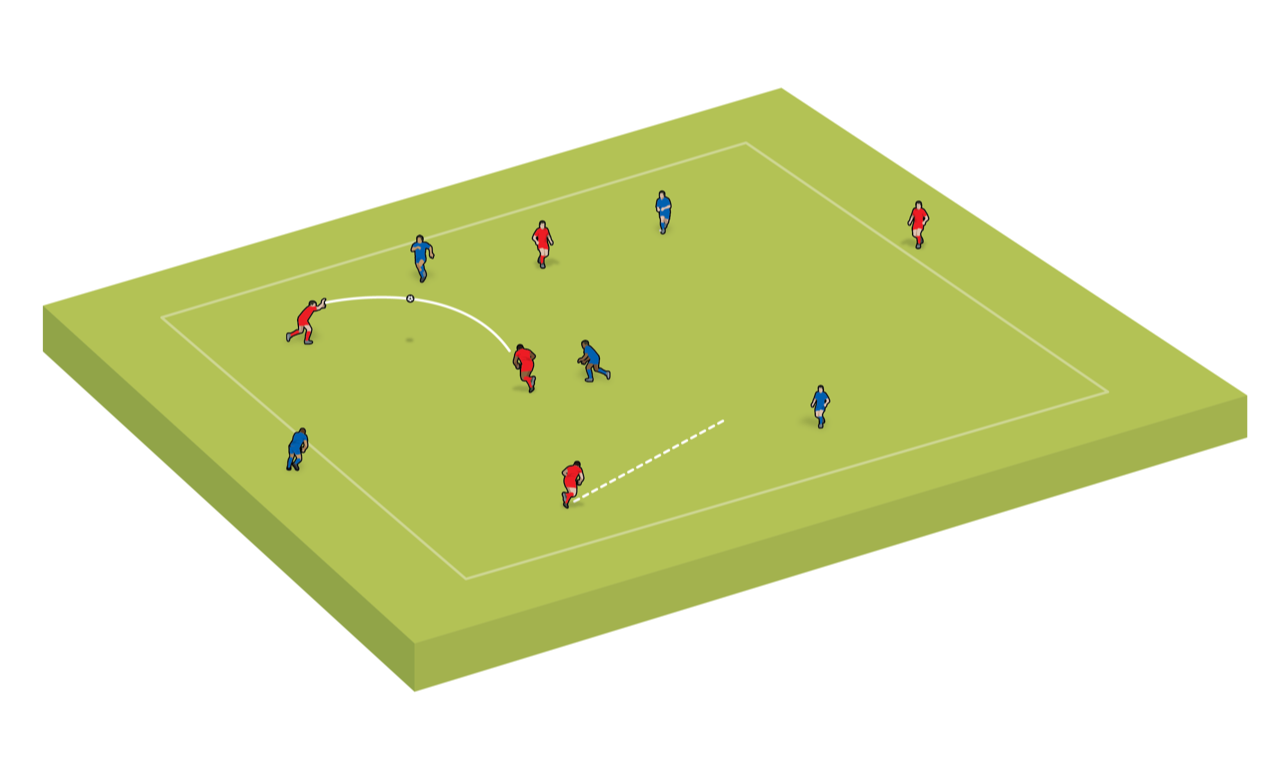
A standard game of handball can be used, with dynamic stretches either integrated, or completed afterwards.
As the game doesn’t allow players to move when in possession of the ball, the speed of the practice is reduced, therefore easing the intensity for the players.
During breaks in the game – maybe once a team has scored a point, or after a certain period of time – players can do some dynamic stretches.
This could be done in the game area, or in a different format – forming a circle, perhaps.
One stretch can be done at a time, before returning to the game, or all stretches can be done at once.
Once the stretches have been completed, the players can either return to handball as it was, or play it with their feet instead of their hands.
If going back to regular handball, let players move when they have the ball so that the intensity of the practice increases.
Examples of dynamic stretches
Dynamic stretches, as opposed to static stretches, are active movements, where joints and muscles go through a full range of motion.
Some examples useful to soccer can include...
- Walking lunges: Step forward into a lunge (both knees bent, torso upright, front knee at a 90-degree angle). A twist of the torso can be added in.
- Leg swings/high kicks: Swing a leg forward and backward, or side to side, in a controlled way.
- High knees: Bring knees up to chest while running.
- Heel kicks: Kick heels up to glutes while running.
- Open the gates: Lift one leg, move it outwards and land it.
- Close the gates: Lift one leg, move it inwards and land it.
- Karaoke/grapevine/crossover: Perform a grapevine pattern while moving sideways –step in front of the other leg, step out to the side and bring the other leg behind you.

Example matchday warm-up timeline
Time until kick-off |
Activity |
| 75 minutes |
Coach arrives and carries out risk assessment |
| 60 minutes |
Coach sets up warm-up area |
| 45 minutes |
Players arrive, coach checks in with them, players begin warm-up |
| 15 minutes |
Players finish warm up and collect equipment |
| 12 minutes |
Team-talk and drinks break - then it’s time for kick-off |
Related Files

Carl Wild
Latest Issue

Subscribe Today
Subscriber Testimonials

Gerald Kearney, Downtown Las Vegas Soccer Club

Paul Butler, Florida, USA

Rick Shields, Springboro, USA

Tony Green, Pierrefonds Titans, Quebec, Canada
Subscribe Today
Newsletter Sign Up



Coaches Testimonials
Gerald Kearney, Downtown Las Vegas Soccer Club
Paul Butler, Florida, USA
Rick Shields, Springboro, USA
Tony Green, Pierrefonds Titans, Quebec, Canada
Subscribe Today
Latest Issue

Discover the simple way to become a more effective, more successful soccer coach
In a recent survey 89% of subscribers said Soccer Coach Weekly makes them more confident, 91% said Soccer Coach Weekly makes them a more effective coach and 93% said Soccer Coach Weekly makes them more inspired.
*includes 3 coaching manuals
Get Weekly Inspiration
All the latest techniques and approaches


Soccer Coach Weekly offers proven and easy to use soccer drills, coaching sessions, practice plans, small-sided games, warm-ups, training tips and advice.
We've been at the cutting edge of soccer coaching since we launched in 2007, creating resources for the grassroots youth coach, following best practice from around the world and insights from the professional game.
